
Visiting the Rojava Revolution in February 2026
Written by citizen journalists Nathan McDonnell & Baudoin who visited the Rojava Revolution in NE Syria in February 2026.
We were very excited for our trip to visit the revolution in Rojava, in Kurdish-majority north-east Syria. In this region, the Kurdish freedom movement is leading the creation of a new society based on direct democracy, women’s liberation, ecology, and the solidarity economy, at the same time as being the best defense against ISIS.
After flying from Beirut (where we have been living for two months), our trip started in Erbil, in Iraqi Kurdistan, known as “Bashur” or South Kurdistan in Kurdish. Since the fall of Saddam Hussein, the Kurds in northern Iraq have a semi-autonomous government, the Kurdistan Regional Government (KRG). It is dominated by the KDP political party which is led by the Barzani family. The KDP is very different from the leftist-dominated Kurdish movements in Turkey and Syria, as the KDP is pro-capitalist, socially conservative, and focused on building a centralized top-down Kurdish nation-state that prioritizes Kurdish identity, despite the ethnic diversity in the territory. Furthermore, due to the KDP’s alliance with Turkey, they submit to Turkey in enforcing a kind of embargo on Rojava and on sharing intelligence about leftist movements in Syria and Turkey.

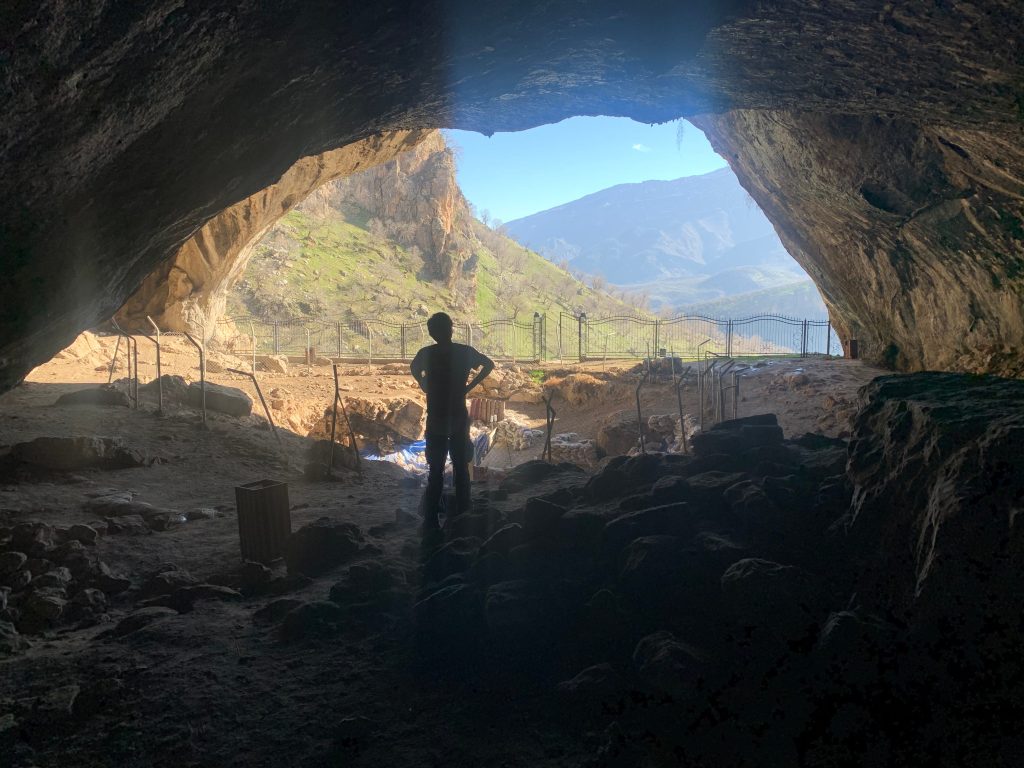
While in Erbil, waiting for two days for our crossing permit, we planned a day trip in the nearby mountains. We followed a road starting from Erbil, passing by Spilk and following the Grand Zad river and valleys. We were invited by a family in the stunning mountain village of Jonala to eat lunch. We visited Shanidar Cave, one of the world’s most important sites for Neanderthal archaeology, as people’s remains have been found 10,000–40,000 years old, and came back to Erbil following a mountain road through the city of Akre. In the evening, we visited some beautiful Christian churches in Erbil (Cathedral of St Joseph and St Elia). The second church commemorated the 2014 Yezidi genocide by Daesh (they were rescued by the Syrian Kurds). It also had beautiful stations of the cross focused on hands. During that day we received confirmation that we will be able to cross to Rojava the following morning, so we came back to our hotel for final preparation and a good rest.

The following day, we did 7 hours of driving from Erbil, across the Iraqi-Syrian border, to Qamishlo in Rojava (Syrian Kurdistan). On the way, we passed many American military trucks that, we assumed, were being transferred from Syria to Iraq. Since the new Syrian government has annexed territory in Rojava, the US is closing down bases in those areas, probably due to fears of attacks from jihadists. We crossed the border at Faysh Khabur (Peshkhabur) at the Tigris River, where we met Catalan and Greek journalists who were also crossing. On the Syrian side, we were picked up by friends who drove us for two hours to Qamishlo.
On the way, we saw oil wells (some destroyed by Turkish bombings) and passed through a few villages that seemed very poor. Rojava is very poor due to years of discrimination, war, and siege from the Syrian and Turkish governments. Most of the forest that once existing in this area was deforested and its wood exported in the other parts of Syria during the Assad regime.
After arriving in Qamishlo, we had a nice lunch before taking a much needed rest. Tomorrow we will start going around, meeting people, and have a better view on the program we will follow in the coming days.
So far it is inspiring to see how people of Rojava have organized a free society around democratic autonomy, women’s empowerment, multiculturalism, and the solidarity economy. And they have been the best fighters against ISIS, including the all-women military units. Since recent attacks by the crypto-jihadist Syrian government, and a recent agreement for a ceasefire and to integrate governments, things are tense and very uncertain. But there is cautious optimism. These people have lived through centuries of oppression and violence and have become experts at survival and self-defense.
We want to say that we are very excited to be here after the uncertainty of crossing the border. We are very grateful for the warm welcome and hospitality we are receiving from our friends here.
Interview with a Former Political Prisoner and Visit of a Neighborhood Direct Democracy Council
On our first morning, we had breakfast at a friend’s house, which we ate seated on the floor as is customary. That morning, we interviewed Cîger Efrîn, an activist and writer who served 30 years and 30 days in a Turkish prison, in which time he wrote 30 books. He was imprisoned due to his involvement in the PKK (the Kurdistan Workers’ Party, historically the main leftist Kurdish activist party and guerilla movement). He joined the PKK in 1987 after growing up in Afrin, where his family instilled pride in Kurdish heritage amid discrimination. He spoke of the movement’s educational approach: before distributing magazine materials to the public, activists would spend three days together intensely studying the materials and discussing Kurdish history and international revolutionary struggles including Palestine, Vietnam, Cuba, Palestine, Soviet Union, Laos, and Angola. He described these years as the most beautiful period of his life, full of a sense of brotherhood, solidarity, hope, and collective pride.
Arrested in 1992 after being shot in multiple places on his body including his head, he endured 16 days of terrible torture and then a sham trial. In prison, he emphasized the power of will and determination, describing how prisons became the frontline of the PKK struggle as so many activists were being detained. To draw attention to the prisoners’ lack of rights and the need for a Turkish-Kurdish peace process, imprisoned activists organized hunger strikes for months on end, inspired by Irish counterparts. They also organized conferences in prison, the first of its kind in the world.

One of the participants in our delegation was a Basque independence activist who was a political prisoner for 7 years because of his involvement in the ETA; afterwards, it was touching to hear his reflections on the meeting and the similarities with his own experience in terms of torture and political activism in and out of prison. When visiting the library and cultural centre in which it took place, I spotted a Kurdish translation of a book that we at Black Rose Books had published in the 1990s, written by eco-anarchist/social ecologist Murray Bookchin: Urbanization without Cities: The Rise and Decline of Citizenship. This book, as well as Bookchin’s ideas generally, would inspire a libertarian socialist and direct democracy influence to the thought of Abdullah Oçalan, the leader of the Kurdish freedom movement.

We visited a nearby football stadium in Qamishlo, known for an infamous massacre by the Assad regime during a football game; the massacre would spark Rojava’s first mass uprising. On a wall of the stadium was a series of 20 political murals immortalizing the history of the Kurdish freedom movement. (We will publish photos of the full series with explanations in a later article.)

We then attended dinner hosted by a family; the mother serves as co-spokesperson for their Commune, which is a neighborhood council run through direct democracy. After dinner, she brought us to their Commune headquarters to meet more of their members who explained Rojava’s bottom-up democratic structure. The Commune is the most grassroots unit of organization and citizen participation of the Revolution in neighborhoods and villages throughout the region.
This particular Commune represents 700 households and has eight thematic committees including women’s issues, public works, defense, health, education, youth, mediation, and families of the martyrs. All representatives on committees are democratically elected delegates, one man and one woman, whose role is to be spokespeople for decisions made by their constituents during meetings open to all. In addition, there are general assemblies held once a month that all the committees report to and are accountable to. They outlined how the Revolution allows for decisions to be made collectively and transparently at the neighborhood level, in a way that is coordinated with other neighborhoods and other cities: from the Commune, to the Council, to the City, to the Canton, and then to the regional administration: the Democratic Autonomous Administration of North-East Syria (DAANES). It is a bottom-up system that maximizes participation, empowerment, and collective responsibility. Their system is volunteer-based, with minimal administrative staff.

Currently, due to the risk of attacks from the crypto-jihadist HTS-led Syrian military, ISIS sleeper cells, and the Turkish military, the Commune operates 24/7; volunteers leading security patrols through the night, as is the case throughout the region.
The meeting concluded with Basque delegation members sharing their independence struggle against colonial powers France and Spain and gifting Basque cheese from one of Europe’s only remaining collectively-owned agricultural lands.
Meeting with Women’s Army Commanders
We went to Hasakeh to the headquarters of the YPJ, the all-women army, to meet with their leaders at a base merely 10km from the frontlines with jihadist HTS. We met with Rohilat Afrin, the woman who is one of the most senior military commanders of Rojava/the Democratic Autonomous Administration of North-East Syria (DAANES) and who participated in ceasefire negotiations with the Syrian government. She spoke candidly about 13 years of the Rojava Revolution — the battles against ISIS and Turkish-backed forces, and the martyrs who lost their lives over the years.

In response to our questions, she also shared about the fragile ongoing integration process with the new Syrian government in Damascus and the red lines that they will not compromise on. These include their right to democratic autonomy in a decentralized government structure and the protection of the rights of women, as well as Kurds and other minorities — in daily life but also in official representation in the Syrian state and military. She emphasized that their military is a source of empowerment and self-defense for oppressed groups. We also discussed that it has a democratic structure as soldiers elect their own leaders who are empowered to give commands. The YPJ press office released this statement about our meeting, with photos and a short video.
The Night Watch and Community Self-Defense

As evening fell, we toured the checkpoints of the neighborhood’s grassroots security systems. Since January, when the jihadist Syrian military invaded with Turkish support, neighborhoods and villages have set up checkpoints throughout the night. These night watch committees are made up of local volunteers, not regular soldiers, and they are given training before bearing arms. Their main mission is to safeguard the area from the threat of invasion, ISIS sleeper cells, Turkish spies, or mafia; in case of the need of an arrest, they call the Asayish (the professional security forces). They are also made up of different generations, young and old, mostly men but also women; their friends and families even join them to keep them company around the fire. The night watch represents the embodiment of the revolution’s principle that security and defense are collective responsibilities, not state functions.
The Rojava Film Commune

The following day, we visited the Rojava Film Commune (Komîna Fîlma a Rojava), founded in 2015 by locals and internationalists to produce revolutionary cinema as an alternative to the capitalist film industry. Their films document real stories from the revolution — battles, family life, women’s liberation — and are made available for free on YouTube with subtitles in multiple languages. They recommend films like: Kobane, about the defence of the city from ISIS attacks, and When Seedlings Grow, about everyday life since the revolution. Despite ongoing war disrupting production, they recently held their first film festival and continue working collectively, as an integral part of society rather than a separate artistic elite. See their website and a short video showcase of their work.
Workshop on “Jineology” — the Science of Women and Life

After lunch, we attended a workshop on “Jineology” — the science of women and life — at the Jineology Academy in Qamishlo. Rooted in the Kurdish word “Jin” (woman), Jineology draws on several scientific fields—archaeology, mythology, anthropology, and sociology—to trace the role of women in ancient matriarchal cultures and the transition to patriarchal domination. Inspired by the writings of Oçalan and Western feminist thought, and critical of positivist science, it constructs a new but fundamental science around the essential role of women in building a robust society.
The movement has built several institutions around these principles: Jinwar (a women-only village as a place of healing), a Jineology faculty at the university, and a network of research centres. In areas that the Syrian government now occupy, such as Aleppo, Tabqa, and Raqqa, jihadist HTS government forces have closed down several of these centers and also removed feminist, Kurdish, and leftist books from libraries.
Workshop on the International Conspiracy to Abduct Abdullah Oçalan
A following workshop delved into the exile and abduction of Abdullah Oçalan, the leader of the Kurdish freedom movement. After he was forced out of Syria in October 1998, Oçalan embarked on an odyssey of exile through Greece, Russia, and Italy. He would be ultimately betrayed by Western nations and, in 1999, captured in Kenya through an international conspiracy involving Turkish, Mossad, and US intelligence services. Since then, he has been imprisoned by Turkey on the island fortress of Imrali, often as its sole prisoner.
In jail, Oçalan would have the time to read and write, rethinking orthodox Marxism, and developing an extensive philosophical framework that critiques both capitalism and traditional leftist approaches, offering a new vision for democratic society rooted in communal self-organization and women’s liberation.
Leave a Reply