
Montreal and Murray Bookchin
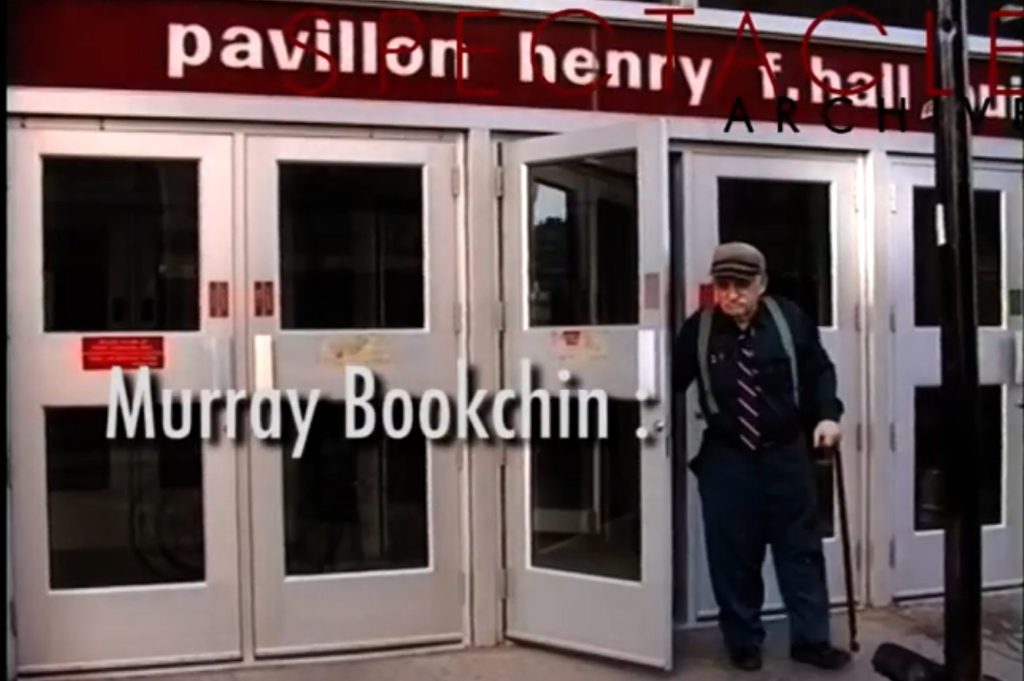
Written by Dimitri Roussopoulos
Few cities, if any, can claim to have and continue to be a laboratory of Social Ecology, like Montreal. To be sure, various aspects of Social Ecology are being applied in Northeasten parts of Syria, namely Rojava. But, major components of Social Ecology, as pioneered and advanced by Murray Bookchin, have been put forward in Montreal in a number of ways and with the use of various means, in both French and English consistently over many decades beginning in the late 1960s to the present day.
This planting of the seeds of Social Ecology goes back to 1960s before Murray Bookchin came to Montreal. From that decade on, the planting included the printing and distribution of pamphlets, newspapers, public talks, study groups, and affinity groups (much of all these activities through the longest functioning anarchist bookstore in North America, Alternatives).
The second part of the 1960s decade in Quebec, and Montreal in particular, included an intensive series of community organizing efforts (animation sociale in French) in both English-speaking and French-speaking neighbourhoods. Much of the territorial mapping of Montreal, demographically, sociologically, and the built environment reflected the Quebec countryside, as thousands in the preceding years flocked to the city for better employment. What emerged were distinct neighbourhoods, with pronounced characteristics such as distinct linguistic, ethnic, and social features. This was also a period of language and political nationalism alongside a left-wing trade unionism. The response of the political elite at the provincial level was liberalization of one government institution or agency after another. While at the municipal level of the metropolis, city hall was frozen in time, with an authoritarianism rigidly maintained through the office of the Mayor.
Where we began our discussions expressing our social concerns in the sixties was around the question of where to seek the locus of fundamental social change in a highly urbanized, industrial society. The conclusion was that the city and its neighbours would be our point of departure. Where was the weight of alienation and exploitation felt, we asked? In addition to the workplace, we felt that this burden was experienced where people live most of the lives—in their neighbourhoods. And it is the reality of their daily problems that make the home/street as oppressive as, and one with, the workplace. We began our reflection by studying the work of Henri Lefebvre, who made a major leap in Marxist theory, drawing for the experience of May–June, 1968, in Paris and France. Lefebvre raised the banner of “the right to the city.”
Because we live in a highly urbanized society with a massive centralization of economic and political power, the major cities became the axles of our society. Therefore it falls upon us in part to develop community organizing strategies accepting the geo-political significance that cities have a major role to play in the fundamental transformation of our society.
Enter Murray Bookchin
By 1968-69, Murray Bookchin ventured to Montreal. He visited the office of the new left international quarterly journal, Our Generation. This journal was founded in 1961 and held the name of Our Generation against Nuclear, the first issue of which had an introduction by Bertrand Russell, and started out as a ‘peace research’ journal, the contents of which evolved in time. It was in 1969 that I had just completed a manuscript on the new left in Canada, commissioned by a major Canadian publisher. During Bookchin’s visit to the city, an exchange took place, with a series of follow-up events, which lead to the founding in late 1969 of Black Rose Books. We published this first book on the new left ourselves with a few hundred dollars and sold over 5,000 copies which set us on the road to book publishing. Murray Bookchin gave us the name of our book publishing project—Black Rose Books. And in 1969, we organized a huge public meeting at which he gave a ringing and brilliant talk entitled, “Revolutionary Anarchism.” Even though it was his first public talk in Montreal, the University Settlement on St.Urbain St. was packed—an indication of the times, and a reflection of the groundwork which we had already seeded.
Janet Biehl, in her magnificent biography of Murray Bookchin, recounts his entry into Montreal, our meetings together and interactions over many years.1 I shall not repeat what she does so well in her book, except to highlight a few events and accomplishments.
Montreal has had for some time, from the 1960s on, a wide range of citizen committees in predominantly poor and working class districts, and much of this social activism was the result of community organizing. Two driving ideas were promoted: Helping to organize the underclass and unorganized, and participatory democracy. Attempts were made to bring these popular groups together. In time, a large number of political action committees were formed in various neighbourhoods which grouped together the local popular groups. These political action committees became the basis of a new left-wing municipal party Front d’action populaire (FRAP).
In essence, the FRAP was a political party that was a federation of local political action committees. In 1970, Montrealers obtained the right to vote at the municipal level for the first time. Previously, only Montreal’s property owners had the right to vote. Given that Montreal had a huge majority of people who were tenants, the preceding elections were hardly a celebration of representative democracy. This same period was a turbulent one of both linguistic and left-wing nationalism throughout Quebec. This movement which sought to separate Quebec from the rest of Canada and form a new nation-state also included a terrorist wing, the Front de libération du Québec (FLQ). November 1970, was the month when Montreal’s municipal elections were scheduled to take place. The terrorist wing played into the hands of the prevailing political class by provoking by a series of actions (bombings, kidnappings, and assassinations), giving an ideal pretext for the Establishment to declare a state of emergency, handing sweeping powers to all police forces and the military. Montreal was put under martial law. More than 700 individual activists were arrested and jailed. Radios announced the arrest of prominent activists, including the author of this essay. In fact a periodical that we were publishing in French, modelled on the English-language quarterly, Our Generation, called Noir et Rouge, had the entire third issue seized by the police and locked in their warehouse for eight months thereafter, after they raided our offices twice. That the issue of this journal was devoted to nonviolent revolution passed the police by. Several FRAP candidates were also arrested. People were afraid to go to the polling stations, as street corners had armed troops and tanks stationed throughout. Needless to say, the authoritarian, outgoing mayor was re-elected, and his party “grabbed” another majority. No candidates won from the FRAP.
For some time thereafter, activists and other concerned citizens where too traumatized by the fall, 1970, events to get on with a renewed wave of community organizing. There were small meetings all over Montreal. And one of the main targets of opposition that was discussed was the Mayor Jean Drapeau and his so-called hand-picked, political party that dominated city council.
Nevertheless, by 1972, social and economic unrest was boiling to the breaking point again. The largest general strike in the history of labour struggles in North America broke out. Some 300,000 unionists not only marched in defiance but also occupied radio stations and factories. The Paris,1968, slogan, “It’s only the beginning, we continue the fight” rang through the streets during mass demonstrations. And at the neighbourhood level, street committees were resurrected again and were getting ready to challenge municipal authoritarianism again. By early 1974, a left-of-center political opposition was ready to publicly surface.
Preceding these events, in 1968, a seminal battle was launched by activists to save a six-block downtown neighbourhood from complete demolition. This struggle spearheaded by community organizers working out the University Settlement was very much inspired by the ideas advanced by the 1960s new left. They wanted to not only prevent outright wanton destruction of a heritage neighbourhood peopled by low-income people but also wanted to create a cooperative community with nonprofit cooperative housing at its core. The door-to-door, public assembly meetings laid the basis for a militant movement which gained support from across the city. The entire drama is analyzed in detail elsewhere.2 Suffice to say, the marches and demonstrations, sit-ins, arrests, and trial and hunger strikes continued into the 1970s. In fact, the struggle continued into the 1980s until victory established the largest nonprofit cooperative housing project on an urban land trust in North America, the Milton-Parc project, including some 1500 citizens now lodged in secure housing. At the core of this organizing in various chapters of its history were four anarchist affinity groups of Social Ecologists very much inspired by the writing and the visits of Murray Bookchin. The essence of the Milton-Parc project was to not have any private property within the six-block downtown neighbour by establishing a land trust, managed by the federated housing co-ops and nonprofit housing associations. In the years that followed, this sociopolitical and economic accomplishment was a step towards the municipalization of urban land as a whole, which in effect took this neighbourhood, its built environment and citizens off the terrain of market capitalism. Indeed under the public surface, even immediately after 1970, neighbourhoods with previous records of social and political activism were quietly buzzing. The roots of renewal were there.
By the spring of 1974, the newly cast urban political left-of-center brought together a mixture of left nationalists of the Parti Québecois, as well as the social democrats of the New Democratic Party and members of the small Community Party, plus some neoMarxist intellectuals rapidly formed the Montreal Citizens Movement (MCM). The fact that it named itself a “movement” rather than an outright political party, reflected the fact that the principle organizers recognized from the start that the base of activism in Montreal had a left libertarian sensibility that had to be taken into account. But, from the start, the MCM chose to focus on individual membership, rather than rebuilding the model of the FRAP.
A few months after it was formed, the MCM faced an election. A stunning victory electing 18 MCM city councillors took place from electoral districts where community organizing was most deeply rooted. The mayor faced a real opposition within city council for the first time. Meanwhile, on the trade union side, the libertarian-leaning Confederation of National Trade Unions (CNTU) issued a sweeping manifesto which stated categorically that unionized workers, were more than workers. They were citizens, and as it true with all citizen or popular neighbourhood organizations, common work had to be undertaken to address issues of housing, transportation, rent controls, and quality-of-life issues. The CNTU manifesto was called “The Second Front,” which indicated a major shift from business unionism, and reflected the social motion that was being stirred.3 Such a shift which also was reflected in one form or another in the other two major trade union federations contributed to the organization along with the radical student union in organizing a mass petition and action in the form of a demonstration of over 10,000 people in front of city hall demanding free public transportation.4
In turn, the MCM began moving steadily to the left. Before 1975, the anarchists and Social Ecologists decided to join and become active at the grassroots of the MCM. By 1975, an openly socialist executive committee was elected, and that year’s MCM congress consolidated nascent ideas germinating among the membership.
These ideas included the decentralization of significant powers from city hall and its municipal council to the neighbourhoods by establishing a series of decision-making neighbourhood councils. Indeed, the MCM challenged the definition of city councillors as they had been strictly mandated and argued for revocable delegates.5 They also adopted a major radical social housing program. These and other propositions were democratically debated at Congress, and eventually lead to an emerging split between electorialists/pragmatists and the large left-wing within the MCM.
Burlington and Montreal
During the mid 1970s to the mid 1990s the telephone calls from Burlington rang almost every second day, during which Murray and I had heavy discussions on what was going on, what should go on, and how to go about applying the politics of Social Ecology. These long discussions continued for years and also included philosophical issues. Meanwhile, Black Rose Books and Our Generation continued to publish essays and articles by Bookchin and others. In fact, a rather influential book, The Politics of Urban Liberation, by Stephen Schechter, a member of the MCM executive committee, became, with the publication of this book, an avowed anarchist, creating further waves of such anarchism.6 The interaction between Murray Bookchin and some of the key left-wingers in the MCM was very fruitful.
The mainstream media were panicking, and eventually, fanned the flames of an internal split, leading to the creation of a new splinter political party, the Municipal Action group (MAG). The stage for the 1978 election. For the first time, just before the election, a number of street committees in downtown Montreal called upon the MCM to not only endorse a civil disobedience action to block a major city street (rue Jeanne-Mance) to through traffic in a campaign to convert it to a residential street again, but also to have MCM city councillors and candidates officially come to the blockade. They did, the street was blocked at traffic time for several hours, and their point was made.
Again, the mainstream media [largely francophone] condemned this “peoples power” action and started a campaign of red baiting against the MCM for trying to create neighbourhood soviets dressed up as neighbourhood councils. The media attacks were almost daily. The results of the 1978 elections and the split on the left-of-center political spectrum resulted in the election of one MCM and one MAG councillor in City Hall, and the remainder of the seats were taken back by the ruling mayor, Jean Drapeau. After this defeat, the youthful left-wingers decided to return to their neighbourhoods and rebuild again, resulting in a political vacuum in the MCM.
From 1978 to 1986, the MCM moved to the center. But the resentment against the ruling mayor was so deep that many community organizations still preferred the “lesser of two bad apples.” By the 1986 elections, the MCM was elected with a majority at city hall (55 seats of 58); in the process it had shed much of its left-wing program. The exception was the desire for decentralization and the creation of neighbourhood councils. Just before the fall 1986 election, however, the MCM leadership decided to shelve this proposal during its first term, and postponed it to a possible second term after the election of 1990. The seeds of a new internal split were planted.
Around this new split, there was a convergence between a political left and a growing ecological left of Social Ecologists. In the meantime, many of the essays of Murray Bookchin were published in the journal Our Generation and also the out-of-print books were brought back into print by Black Rose Books, with Murray busy writing new introductions and acknowledgements. All of these publications were proposed by mutual and verbal agreements between us. The common objective was to maintain in circulation a body of Social Ecology, while at the same time, arranging public lectures in various cities like Halifax, Montreal, Toronto, and Vancouver. I, for one, was committed to the wide range of these ideas, as we planned various activities and book projects into the 1990s.7 To this end I also helped found a French-language book publishing project, Les Éditions Écosocieté, also devoted to Social Ecology, and in its 25-year history has published the works of Janet Biehl, Murray Bookchin, Chaia Heller, and other Social Ecologists. This publishing programme has also contributed to a growing interest in Social Ecology in France and other French-speaking regions in Europe. Black Rose Books and I personally, did everything we could to assure that Murray Bookchin’s books were translated and published in Turkish, Greek, Italian, and French amongst other languages, and by radical publishers. All of this work was done without bourgeois agreements between author and publisher as is the common practice since its founding with Black Rose Books. Our common objective was, get the works out there by all means and as widely as possible.
The Politics of Social Ecology
During this period, innovative green parties began to emerge in Europe and elsewhere. Ecological consciousness was making a larger and more informed impact. By 1988-89, a number of MCM city councillors and members had enough, and resigned from the political party. On the other hand, the Social Ecologists began forming the basis of a municipal ecology party seeking to put libertarian municipalism as such into practice. In December 1989, a well-attended congress took place, and Ecology Montreal was born. At a major public lecture at McGill University in February 1990, Murray Bookchin in another brilliant presentation gave an unqualified endorsement to Ecology Montreal, before several hundred young enthusiasts. Various smaller meetings followed to flesh out what had to be done and how. Both of us continued to not only to interact on a regular basis but continued to refine the politics of Social Ecology. The Montreal election was set for the fall, and we presented 21 candidates, ten women and eleven men, with no candidate for mayor. The Social Ecology programme of Ecology Montreal was well received, but the election results, given the first-past-the-post electoral system, gave three of our candidates second class standings in votes (I came in second with the highest percentage).8 A further attempt took place in the elections of 1994, but this time, the MCM itself was defeated by a right-wing political party and what followed is a whole story in itself.
What the Social Ecologists decided to do after 1994 was go back to a program of political education, conferences, seminars, and workshops, having concluded that the groundwork for a successful electoral victory was not to be had in the foreseeable future. From the Milton-Parc project base, we founded the Urban Ecology Center of Montreal (UECM) in 1996. For the following ten years, we promoted Social Ecology in a variety of ways, education and projects on the ground. Slowly, we not only influenced the best of the environmentalists to consider a more radical ecological approach, but also in line with advancing the basic concept that our society, and the social relations therein, had to be changed, a plethora of community organizations across the city began echoing ecological concerns in their thinking and actions. The subname of the UECM was “Toward an Ecological and Democratic City” and included everything that that entailed. We also published a biweekly, bilingual newspaper which over time climbed to a circulation of 30,000, distributed in the central areas of Montreal. At the UECM, Murray Bookchin’s influence was felt throughout, and the several lectures that I arranged at the School of Community Studies and Public Affairs of Concordia University, based on his books, Urbanization without Cities and The Limits of the City were a resounding success.9 The many participants wanted more and the various pamphlets and reprints helped, as well as the numerous follow-up workshops at the UECM.
The Impact – Bringing Citizens Together
During these ten years, starting from 2001—and inspired by the process and practice of the World Social Forum—the UECM with other community organizations and four university faculties from the French- and English-language schools held a series of five citizen summits. The first started with some 240 participants, and by the fifth citizens’ summit in 2005, over one thousand Montreal citizens and activists came together. Along the way, Montreal’s city council and new mayor held their own citizens’ summit. This clearly included us and brought together several thousand people who discussed several major subjects: Democracy, the urban environment, housing, economic development, and urban planning. What resulted from this experience—and clearly influenced by us—was a municipal taskforce, headed by myself, which established over an eight-year period, a major municipal office of ongoing public consultation; the adoption of a Montreal Charter of Citizen Rights. This charter protects any person in the city, Canadian citizen or not, the homeless, and other citizens, and recognizes the right of citizen initiatives whereby Montrealers can initiate major public consultations on important public policies in between elections (moving a consultative democratic system to a more participative one). As well, it established an ombudsman’s office that arbitrates conflicts between citizens, politicians, and bureaucrats. Also along the way, Montreal became the most decentralized city in North America, fulfilling a goal cherished by the urban left for decades. Borough councils were established in all 19 Montreal boroughs, each consisting of a borough mayor and city and borough councillors. Elected every four years, each borough council has its own budget based on the borough’s population. Every month, meetings from the city council to the various borough councils are preceded by a citizen question period during which citizen requests for actions can also be made. All of these reforms which were once thought of by the media and the Establishment as adventurous dreams are now continually nurturing the political culture of the city. In this emergent political culture, it is now not uncommon to have Montrealers identify themselves as urban citizens, as citizens of the city, first and foremost.
Assembly Democracy
Other sections of Quebec and Montreal society have also been deeply affected by our activities. Students, both at secondary and university levels, have an ongoing radical democratic sensibility. In 2012, students had a massive general strike organized on March 22nd (recalling the student Mouvement du 22 Mars in in Nanterre, France, 1968) and advancing many of the same ideas. It grew from 185,000 to 200,000 over many noisy days. Neighbourhood solidarity committees quickly came into being, banging kettles and pans when demonstrations were taking place in the streets (les “Casseroles”). In 2018 and again in 2019, more student strikes ranging from 50,000 to 40,000 occurred (the latter over a five-day strike). What is significant to note is that these student strikes were all organized through decentralized general assemblies throughout Quebec, making decisions together by means of a directly democratic federal structure, which were rather leaderless. The issues that preoccupy students have ranged from issues of social injustice affecting them directly, to climate change. The years 2018 and 2019 saw more than 60,000 young people march through the streets of Montreal, demanding “not climate change but system change.”
Finally, at the level of community politics, the social housing movement has moved toward the perspective of a solidarity economy based on land trusts, raising the issue of the municipalization of urban land which was reflected in the “Montreal Declaration” noted above. This approach was adopted at major gatherings of community activists in November 2018, and again in April 2019, where some 400 people gathered to discuss, debate, and plan future grassroots actions. In fact, the April conference was an international one, as activists came from New York City and Jackson, Mississippi, and as far west as Vancouver.
As this short essay indicates, the basics of Social Ecology has made its mark and continues to do so in Montreal. When Murray Bookchin died in 2006, a major article, dedicated to him, appeared in the leading French-language daily, Le Devoir. And when a new book is published on Social Ecology, citing Murray Bookchin, Le Devoir devotes major review space.
Time and circumstances will determine where this process will lead next. But, in the meantime, a new generation joining an older generation is pushing forward with much determination. Clearly the genius of Murray Bookchin is still present.
References
1. Janet Biehl, Ecology or Catastrophe – the Life of Murray Bookchin (Oxford: Oxford University Press, 2015).
2. Josh Hawley and Dimitri Roussopoulos, Villages in Cities – Community Land Ownership, Cooperative Housing, and the Milton-Park Story (Montreal: Black Rose Books, 2018).
3. Marcel Pepin, Quebec Labour: The Confederation of National Trade Unions: Yesterday and Today (Montreal: Black Rose Books, 1972).
4. Judith Dellhein and Jason Prince (eds), Free Public Transport – And Why We Don’t Pay to Ride Elevators (Montreal: Black Rose Books, 2018).
5. Timothy Lloyd Thomas, A City With a Difference – The Rise and Fall of the Montreal Citizen’s Movement (Montreal: Véhicule Press, 1997): 57.
6. Stephen Schecter, Politics of Urban Liberation (Montreal: Black Rose Books, 1978).
7. “District 25,” (Demos Media, Montreal. National Film Board of Canada, Montreal, 1992). Available at: https://www.mcintyre.ca/titles/NFB521379. Accessed: September 5, 2019.
8. Karen Herland, People,Potholes and City Politics (Montreal: Black Rose Books, 1992): p. 209.
9. Murray Bookchin, Urbanization Without Cities: The Rise and Decline of Citizenship, 1st Edition (Montreal: Black Rose Books, 1992); Bookchin, Limits of the City (Montreal: Black Rose Books, 1986).
Leave a Reply