
Bookchin and the Legacy of Direct Democracy
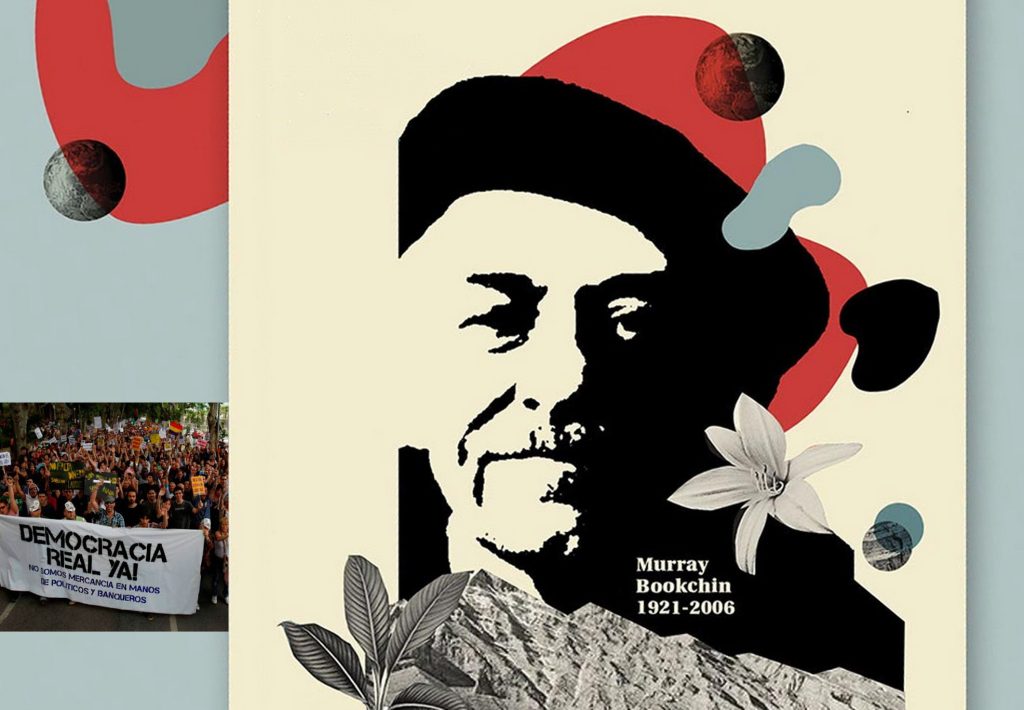
Written by Yavor Tarinski. Cross-posted from Social Ecology & Communalism Workshop.
[Murray Bookchin] was a true son of the Enlightenment in his respect for clear thought and moral responsibility and in his honest, uncompromising search for a realistic hope.
~Ursula K. Le Guin[1]
With the fall of the Soviet Union, but also with the continuous inability of left-wing parties to alter the current state of things through reforms from within the system, the traditional political organizations have become largely marginal, with little to no genuine linkage to society. Rudi Dutschke’s strategy of “the long march through the institutions” is repeatedly failing to achieve anything different from the absorption of the Left by the dominant institutions it tries to change. Society at large have lost trust in the parliamentary model and its inability to cope with the crucial crises of our time: climate change, extreme inequality, concentration of power in the hands of few. Prove for that are the rising levels of abstention in elections worldwide.
The contemporary social movements have abandoned the traditional forms of the past – political parties and trade unions. Instead they have adopted in their practices the project of direct democracy. Although at different places the terms each movement uses might differ, there are common traces of attempts at popular self-institution. From the cooperative network Cooperative Jackson in Mississippi (USA), through the assembly of assemblies, established by the French Yellow Vests, to the democratic confederation in Northern Syria, people are trying to establish radically different institutions, which to embody attitudes and values that go beyond statecraft and capitalism. This self-institution strives at giving practical form to direct communal participation, solidarity, egalitarianism and feminism, and in this way to challenge the temporal and spatial stagnation produced by the bureaucratic fragmentation of everyday life and capitalist cannibalism.
It is no wonder that in this environment there is a revived interest in the ideas developed by the libertarian theorist Murray Bookchin, along other radical thinkers like Cornelius Castoriadis and Hannah Arendt. Bookchin’s works on direct democracy and social ecology seem to directly resonate with the practices of countless contemporary social movements worldwide: from political initiatives directly or indirectly referring him or his concepts, to social media memes like the infamous “Google Murray Bookchin”, which has even been reproduced beyond the internet[2]. For him, the question was not simply to outbid capitalism through an alternative economic model or unconventional lifestyle, as such logic operates within the framework of the contemporary system and its power dynamics. As he wrote, even though such approach may “imbue individuals with collectivist values and concerns, it does not provide the institutional means for acquiring collective power.”[3]
Bookchin suggested that our struggles should be focused on the political question of power, i.e. the question of who has to decide on what course our communities in particular and our society in general should take. His political project, as he himself puts it, is decidedly a confrontational form of face-to-face democratic, antistatist politics.[4] Thorough his work, Bookchin seeks to relocate the space within which political power should be exercised so as to allow the greatest possible freedom to all members of society. He moves beyond the Nation-State, as it alienates the great majority from the decision-making processes, vesting almost all authority in the hands of narrow bureaucratic and managerial stratum. He sought another space – this of the municipality – which during significant part of human history, allowed to communities to directly self-manage their common affairs. As Bookchin writes, between amorphous communities and the institutions of the nation State, the municipal offers a sphere of political activity and a domain for the exercise of power that can politically structure the former, while undermining and displacing the latter.[5]
We see how this logic resonates with contemporary urban and ecological movements. Movements like the Occupy, the indignants of Europe, the Arab Spring, the Yellow Vests of France, the Kurdish liberation movement, the Zapatistas and many more, all seek to reclaim power away from the bureaucratic structure of the Nation-State and transnational capitalist agreements. Instead, they almost instinctively attempt to recreate it on more humane, grassroots scale, where all members of the community will have access to it.
The Ancient Athenian experience
Ancient Athens was an important historical source for Bookchin, which helped him develop his democratic project. He was aware of the problematic issues of classical Athens: patriarchy, slavery, restriction of citizenship to males of putative Athenian birth, etc. But unlike many others from the Western world, who rushed to dismiss Ancient Athens altogether due to these facts, Bookchin noticed something, which was of greatest importance for the human history – the emergence of genuine direct democracy. This view of his resonates heavily with Castoriadis, according to whom slavery existed everywhere in the ancient world, but democracy did not[6]. It was a political project that had nothing to do with the pseudo-democratic parliamentary regime that we know today. Instead, it was based on the concept of the Polis: i.e. the direct self-management of all city dwellers in face-to-face assemblies — in which policy is formulated by the resident citizenry and administration is executed by mandated and delegated councils.[7]
Bookchin’s fascination with Ancient Athens never made him place it on a pedestal or turn it into a “model” or “ideal” to be mindlessly copied today. He was much more astute than that. First and foremost, he discovered in the Athenian polis evidence that society can function rationally for centuries through genuinely democratic structures like popular assemblies, sortition (selection by lot), rotation of offices, revocability of delegates, and defense by the whole of the citizen body (without the need of professional military structure)[8]. Furthermore, he was fascinated with the fact that while the ancient world of that period was dominated by authoritarian empires, patriarchy, and repressive customs, the ancient Athenians managed to imagine, and subsequently to implement into practice, a completely different style of management of society.
Bookchin, similarly to Castoriadis, managed to overcome the sterile frames of classic ideologies and see Ancient Athens’ importance within its contextual environment, something which not that many thinkers have managed to do to this day. As he himself suggests: it would be naive to suppose that Athens could have risen above the most basic attributes of ancient society in its day, which, from a distance of 2,400 years we now have the privilege of judging as ugly and inhuman. Regrettably, no small number of people today are willing to judge the past by the present.[9] His vision for a direct democratic society was not a sterile, heavily ideologized one. Instead, he attempted to seek its seed within different temporal and spatial contexts. It is no wonder that nowadays people from so different areas and political backgrounds find Bookchin’s work so relatable: just think of his impact on European municipalists, as well as on the Middle Eastern Kurds.
Of course, Ancient Athens was not the only historic reference point for Bookchin. He examined various democratic experiences throughout human history. The Paris Commune and the Spanish Civil War were among the cases which influenced and inspired his works. Such relatively recent historic experiences are widely accepted by anarchists and leftists, as they have taken place within the timeframe of classic ideologies. What sets Bookchin apart from most of his contemporaries is that he developed analysis, which allow us to operate beyond sterile ideological veils and detect traces of direct democracy and political ecology within significantly different temporal and spatial contexts. This might prove of even greater importance in our own age of neoliberal globalization, which strives to uproot each one of us from his local history and traditions, and replace them with sterile nationalisms that dull creativity and cooperation and can only inspire hate and divisions.
Institutions
For Bookchin, the institutions of direct democracy are what makes the exercise of nonstatist and anticapitalist power possible and effective. He emphasized on the importance of popular assemblies, municipal councils, confederal co-ordinational bodies of delegates etc., for the successful functioning and reproduction of a democratic and ecological society. Bookchin was convinced opponent of anomie – the idea that given community could function without any laws or norms. For him this concept was grossly fallacious[10]. He suggested that, unlike animals, which can live without institutions (often because their behavior is imprinted in them genetically), human beings require institutions, however simple or complex, to mold their societies[11]. Since the 1960s, Bookchin has been insisting that the institutions of a direct democratic society will be rationally constituted “forms of freedom” by which people would organize and express their own powers collectively as well as personally[12].
Bookchin was certainly not alone on this topic. Castoriadis also agreed that whatever the degree of individual development, technical progress, or economic abundance, people will always need political institutions in order to be able to tackle the innumerable problems people’s collective existence constantly raises[13].
But while Bookchin was not alone regarding the importance of institutions, there were certainly some traces of anomie among the anarchist movement, with which the latter gradually alienated the former. He felt disturbed by anarchist slogans like “Make war on institutions, not on people”[14] as they indicated certain belief in a utopia of unbounded self-determination. But Bookchin traced these germs of anomie back to some of the founders of anarchism as well. For example, he was problematized with Proudhon’s stance towards constitutions as such. Bookchin notes that while Proudhon was a member of the French Chamber of Deputies in the mid-19th century, the latter refused to vote in favor of a draft Constitution that was oriented toward the protection of property and the construction of a State[15]. Bookchin ultimately agreed with his negative vote, but thoroughly rejected the reasons he gave for it. The reason Proudhon gave for his negative vote was that he did not vote against the Constitution because it was good or bad, but because it was a Constitution. For Bookchin this logic reduced the classicist of anarchism to the world of arbitrary power[16]. Furthermore, Bookchin examined a historic trend, according to which oppressed people from the antiquity, like the peasants of Ancient Greece (such as Hesiod), demand a society based on laws, not on the whims of men. In short, he concluded that constitutions and laws have long been demands of oppressed people as instrumentalities for controlling, indeed eliminating, the arbitrary power exercised by kings, tyrants, nobles, and dictators.
The direct-democratic foundations of the society which Bookchin envisioned, went beyond anarchist rejections of laws and constitutions. For him it was not enough to place our hopes for more just future on intrinsic human instincts for mutual aid or sharing. Instead social movements have to propose and attempt to implement in practice new political architecture, which will make possible for the whole of society to exercise power in a stateless, noncapitalist and participatory manner.
Many have come to suggest that one such direct-democratically structured community will consume too much of the participants’ time. But Bookchin is clear on the differentiation between policy making and administration[17]. In his vision of direct democracy, all members of society, by the means of regular public assemblies, will determine the general course of their collective life, its regulative framework etc. Then each of these decisions will be implemented by the means of local and municipal councils, consisted of revocable and accountable delegates and experts.
Regarding this issue, Bookchin provides the following example: The decision to build a road, for example, does not mean that everyone must know how to design and construct one. That is a job for engineers, who can offer alternative designs–a very important political function of experts, to be sure, but one whose soundness the people in assembly can be free to decide. To design and construct a road is strictly an administrative responsibility, albeit one that always open to public scrutiny.[18]
For Bookchin the need of the establishment of democratic institutions was invaluable aspect of his political project. Such social self-instituting allowed for the development of clear distinction between logistical problems and political ones.
On majority voting
After examining Bookchin’s main historical sources for direct democracy and his stance on institutions, one can understand his position regarding majority voting. First of all, he was problematized with the view, held by many anarchists, of democracy as a form of “rule-over” or even “domination”. Bookchin noted that this opinion was shared even by thinkers like Peter Marshall, of whom he spoke with respect[19].
Similarly, with the adoption of the logic of anomie by radicals, many took for granted that majorities automatically translates into coercion and suppression. Bookchin however, was careful enough to not enter this trap. He suggested that in a free society, built on direct democracy, that not only permitted but fostered the fullest degree of dissent, whose podiums at assemblies and whose media were open to the fullest expression of all views, whose institutions were truly forums for discussion — one may reasonably ask whether such a society would actually “dictate” to anyone when it had to arrive at a decision that concerned the public welfare[20].
For Bookchin, majorities are vital for a society to make dynamic collective decisions about public affairs. Furthermore, according to him majority voting is the only equitable way for a large number of people to make decisions[21]. In the conditions of direct democracy, minorities will always be allowed to express their disagreement with the decisions of the majority, but they will still have to obey them. He observed the case of the Athenian polis, where majority voting was also used, and besides all its shortcomings, it still remains as one of the most remarkable examples of highest sense of citizenship.
Bookchin was highly critical of those who viewed consensus as the only decision-making process suitable for a libertarian project. And while he recognized its potentials for small-scale groups, whose members are highly familiar with one another, he pointed at multiple problematic consequences when attempted to implement on larger-scales. First of all, Bookchin recognized that consensus allows for insidious authoritarianism and manipulations to take place as it creates the conditions for single individuals to be able to veto majority decisions, threatens to abolish society as such[22]. To those who supported consensus instead of majority voting, from the liberal position of the fear of the masses, Bookchin reminded that humanity has eaten of the fruit of knowledge, and its memories are laden with history and experience. In a lived mode of freedom – contrary to mere café chatter – the rights of minorities to express their dissenting views will always be protected as fully as the rights of majorities. Any abridgements of those rights would be instantly corrected by the community – hopefully gently, but if unavoidable, forcefully – lest social life collapse into sheer chaos[23].
Elections and citizen culture
There is a certain misconception regarding Bookchin’s view on municipal elections, which can be felt nowadays. Many make it sound as if for him participation in local electoral processes is the main strategy and everything else must follow afterwards. But Bookchin is clear that grassroots assemblies and movements are the only real school for citizenship[24]. He places greatest importance on the creation of living and creative political realm that can give rise to people who take management of public affairs seriously.
Bookchin makes clear distinction between vote-casters (who vote once in several years for representatives), and active citizens that take active participation in the management of public affairs. So, his proposal is not simply shifting the focus from national to municipal elections, but a more holistic one, which implies the creation of genuine public sphere, which to embed participation, cooperation and communal attitude in everyday life. He positions this sphere in direct opposition to the current state of commodification, rivalry, anomie, and egoism, in which there is no real public.
Bookchin’s strategy includes the establishment of different political architecture, which will foster direct civic participation. This means rallying social movements into organizing their struggles, and consequently their very communities, on the basis of grassroots decision-making bodies like popular assemblies, and then eventually sending revocable delegates of theirs to participate in municipal elections. We observe something similar to be taking place with the movement of the Yellow Vests in France, which began as popular uprising, but gradually formed local assemblies, which then began attempts at confederating with each other. It is from this level, Bookchin suggests, that such emancipated democratic collectivities should reclaim their municipal councils away from bureaucratic and statist control.
His mistrust of contemporary electoral processes is evident from his opinion of political parties as a kind of mimicry of the statecraft mechanism. As Bookchin writes, a “political party” is normally a structured hierarchy, fleshed out by a membership that functions in a top-down manner. It is a miniature state, and in some countries, such as the former Soviet Union and Nazi Germany, a party actually constituted the state itself. The Soviet and Nazi examples of the party qua state were the logical extension of the party into the state. Indeed, every party has its roots in the state, not in the citizenry. The conventional party is hitched to the state like a garment to a mannikin.[25]
So Bookchin doesn’t propose to simply redirect our efforts from national parties to municipal ones. Instead, he views the municipal electoral level as a suitable field for wider coordination between local communities in the form of neighborhoods, towns or villages. But it remains useless if the political essence of these communities is not radically altered in direct democratic direction. Bookchin suggests regarding the creation of new municipal agenda, that unless we take our commitment to real democracy seriously, we will get entangled with some kind of bureaucratic structure, which is incompatible with a vibrant citizentry.[26]
Conclusion
Bookchin’s legacy is already playing an important role in the development of the agendas of social movements worldwide. And this seems more than logical. His legacy departs from the grand narratives of classic ideologies and contemporary lifestyles, and instead endures into the development of strategies and institutions, which to give practical forms to freedom.
During his life he has moved through various political tendencies, but always in the search for greater emancipation and popular participation. Bookchin’s departure from anarchism hasn’t been, as some might bad heartedly suggest, a result of a conservative lurch of his. Instead, he attempted to overcome the boundaries of anarchist thought and advance further the project of direct democracy.
It is no wonder that Ursula le Guin wrote in her unique style that Bookchin is no grim puritan. I first read him as an anarchist, probably the most eloquent and thoughtful one of his generation, and in moving away from anarchism he hasn’t lost his sense of the joy of freedom. He doesn’t want to see that joy, that freedom, come crashing down, yet again, among the ruins of its own euphoric irresponsibility.[27]
[1] Murray Bookchin: The Next Revolution: Popular Assemblies & the Promise of Direct Democracy (New York; Verso 2015) p9
[2] https://knowyourmeme.com/memes/google-murray-bookchin
[3] Murray Bookchin: Thoughts on Libertarian Municipalism, published in Left Green Perspective #41 (January 2000)
[4] Op. cit. 4
[5] Op. cit. 4
[6] Cornelius Castoriadis: The Problem of Democracy Today, published in Democracy & Nature, The International Journal of Politics and Ecology, Vol. 3, No. 2 (issue 8, 1997) pp 18-35
[7] Murray Bookchin: Communalism: The democratic dimension of anarchism, published in Democracy & Nature Vol. 3, No. 2 (Issue 8, 1995) pp1-17
[8] Op. cit. 8
[9] Op. cit. 8
[10] Op. cit. 4
[11] Op. cit. 4
[12] Op. cit. 4
[13] Cornelius Castoriadis: The Castoriadis Reader (D.A.Curtis, Ed., Oxford: Blackwell, 1997) p189
[14] Op. cit. 4
[15] Op. cit. 4
[16] Op. cit. 4
[17] Op. cit. 8
[18] Murray Bookchin: Urbanization without Cities: The Rise and Decline of Citizenship (New York; Black Rose Books 1992) p247
[19] Op. cit. 8
[20] Op. cit. 8
[21] https://theanarchistlibrary.org/library/murray-bookchin-the-communalist-project
[22] https://theanarchistlibrary.org/library/murray-bookchin-the-communalist-project
[23] https://theanarchistlibrary.org/library/murray-bookchin-the-communalist-project
[24] Murray Bookchin: The Murray Bookchin Reader (New York: Black Rose Books 1999) p182
[25] Murray Bookchin: The Murray Bookchin Reader (New York: Black Rose Books 1999) p174
[26] https://theanarchistlibrary.org/library/murray-bookchin-libertarian-municipalism-the-new-municipal-agenda
[27] https://www.vice.com/en_us/article/vvbxqd/ursula-le-guin-future-of-the-left
Leave a Reply