
Interview with Andriy Movchan, who sailed to Gaza with the Global Sumud Flotilla
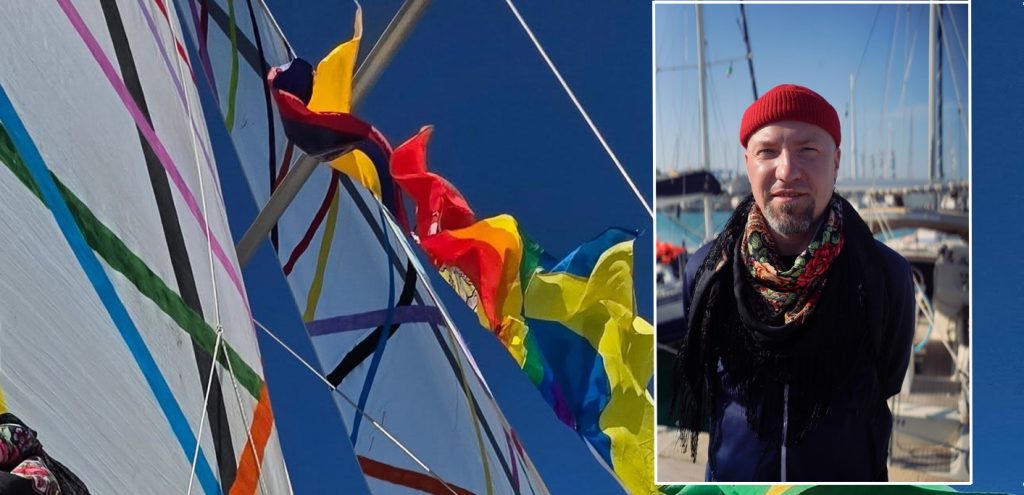
Ukrainian leftist activists Andriy Movchan and Nina Potarska sailed with the Global Sumud Flotilla to Gaza. Today we share an interview with Andriy, conducted by the Greek libertarian journal Aftoleksi, about their experience, their capture by the Israeli army, and the reasons that led him to participate in the Flotilla and unite the struggles against war and occupation.
Aftoleksi: Thank you for taking the time to talk to us! For starters, please introduce yourself for our readers.
Movchan: My name is Andriy Movchan, and I am Ukrainian. I was born and raised in Kyiv. Back in my home country, I was a journalist and a left-wing activist. I was an active member of the student anarcho-syndicalist union Pryama Diia(“Direct Action”), as well as have taken part in Marxist organizations and the anti-fascist movement. Due to political persecution by the far right, I was forced to leave the country. At the end of 2014, I moved to Spain, where I later received political asylum.
I have now lived in Catalonia for ten years, speak Catalan, and have many acquaintances among the local left. Throughout my years in exile, I was sharply critical of political developments in Ukraine. My Catalan left-wing acquaintances fully welcomed this criticism, as it fit comfortably within their political dogmas.
But in 2022, I was horrified to discover that a large share of my left-wing friends and acquaintances tolerated the Russian invasion and occupation of my country. It came as a shock. I found new like-minded comrades in the European Network for Solidarity with Ukraine — a network of left-wing organizations that support Ukraine’s just resistance to Russian aggression.
A: What made you join the Global Sumud Flotilla in the first place?
M: Back in September 2025, when the first flotilla set sail for Gaza, I firmly decided that Ukraine had to be represented in the next mission. That my place was there, among those people. That I had to make it onto the next flotilla no matter what. Once I set that goal for myself, I did everything possible to make it a reality.
What motivated me? My goal was first and foremost to challenge the illegal Israeli blockade of the Gaza Strip. But I also wanted to break through a wall of stereotypes.
First, I wanted to challenge stereotypes within Ukrainian society, where many people have been misled by Israeli propaganda. Many Ukrainians came to believe that Israel is a “victim” merely “defending itself.” Some came to believe that Palestinians are not a real nation. Some came to believe that Palestinians are nothing more than “Iranian proxies.” Unfortunately, Ukraine’s information space on the Middle East question is literally occupied by Israeli commentators. We wanted, at last, to give Palestine a voice in the Ukrainian media space.
Second, I wanted to challenge the stereotype shaped by Russian propaganda in the rest of the world — the claim that all Ukrainians are “passionate supporters of Zionism” and “enthusiastically back the genocide of the Palestinian people”. Unfortunately, this narrative is instrumentalized by many left-wing movements in order to deliberately attack any expressions of solidarity with Ukraine’s resistance.
The presence of Ukrainians on the flotilla is something that challenges both of these stereotypes. And I think we managed to achieve some success in doing so.
A: Can you tell us what happened when the Israeli military illegally intercepted your boat and abducted you in international waters?
M: Frankly, we did not expect the first interception to happen so quickly. After departing from Sicily, we had been at sea for only four days. When the captain told us to prepare for an interception, until the very last moment I thought it was the Greek coast guard, because we were only approaching Crete. But when I heard the Israeli accent of the soldiers, it was a shock. An interception 700 nautical miles from the coast of Palestine!
We were taken off the yacht by motorboats and transferred to an Israeli prison ship. On its deck, a kind of mini concentration camp had been set up specifically for the flotilla participants. My personal belongings and jacket were confiscated, and I was forced face down onto the floor. Some of my comrades were beaten, forced to kiss the Israeli flag, and subjected to various forms of humiliation.
The camp consisted of three shipping containers where we were supposed to stay. But there was far too little space for 180 people. So more than half of us had to remain on deck the entire time, under the scorching sun during the day and in the rain at night. I was “lucky” — both nights I slept inside a container. One of the forms of abuse, notably, was that before dawn the Israelis flooded the deck with water, where dozens of people had been sleeping.
In addition, Israeli soldiers several times stormed onto the deck with weapons. They used stun grenades in the confined space to intimidate us. At gunpoint, they forced people into the containers and kept them there, not even allowing them to go to the toilet. I had to relieve myself into a plastic bottle.
On the second morning, a mass beating took place. We declared a strike in protest against the isolation of six of our comrades. In response, the soldiers used force against dozens of activists. Women were dragged by their hair. Some people were slammed against the containers. One man was shot in the leg with a rubber bullet. When I was forced face down in a corridor, there was a pool of blood beside me.
After a day and a half in this floating prison, we were handed over to the Greek authorities on the western coast of Crete. In a certain sense, we were fortunate that we were not taken to a land-based Israeli prison. Those who were intercepted later near Cyprus, as far as I know, experienced the worst moments on shore in Ashdod.
A: Yes, it seems so… Now that you’ve returned safely and can look at things with some perspective, how would you assess the general stance of the other activists in the Flotilla regarding the invasion of Ukraine?
M: I had many concerns about how the participation of Ukrainians would be received by the rest of the flotilla activists. It is no secret that a certain part of the pro-Palestinian movement consists of Stalinists who openly support the Russian invasion. In a certain sense, I feared a Stalinist conspiracy against the Ukrainian participants more than I feared the Israeli military.
However, my fears proved unfounded. The other participants were glad to have Ukrainians among them. They understood how important our participation was for the movement as a whole, and for our own society.
What is more, to my sincere surprise, I met many people there who, at different stages, had actively helped Ukraine. There were medics who treated our wounded civilians and soldiers. There were volunteers who delivered humanitarian aid to frontline cities. There were journalists who reported on the life of the country and its resistance to aggression. There were also left-wing activists who, in their own countries, oppose Russian propaganda.
Speaking of the general mood, there were people there who prioritize the struggle against Western imperialism. And to a certain extent, this is understandable — people see it as their duty to fight where it is their own governments that are in the wrong (I wish to see the same level of intransigence toward “their own” imperialism among Russian leftists!). The Ukrainian issue was certainly secondary there.
There were also people who were more tolerant of Russian imperialism than I, and other Ukrainians, would have liked. But not once did I encounter openly hostile attitudes toward us or toward Ukraine. Not once did I hear approval of Russian aggression. That genuinely surprised me in a positive way.
A: Unfortunately, we often see people expressing their solidarity with the Palestinian people while remaining silent about the people of Ukraine. And vice versa. It is important, therefore, to speak to people, highlighting the parallels between the two issues.?
M: You are right. While the Ukrainian and Palestinian cases are far from identical – with many differences between them – there are also parallels, and they are quite obvious. Even greater are the parallels between the actions of the aggressors.
Both Russia and Israel are invaders and occupiers. Both Russia and Israel act according to the “law of the strongest,” possessing superior military capabilities and nuclear weapons. Both deny the very existence of the nations they subjugate. Both grossly violate international law, considering it an overly recent concept. To justify their “right” to the lands they have seized, they appeal to millennia-old mythology. Russia and Israel are effectively the only states in the world that practice direct annexation. Both practice settler colonization in order to deliberately change the ethnic composition of occupied territories.
One can also find parallels of another kind. For example, in the fact that neither Ukrainian nor Palestinian resistance is perfect. In both cases, there are clearly visible nationalist and reactionary elements. This is predictable – nationalist and fundamentalist factions are always more motivated to engage in armed resistance than others in wars of national survival. But does this justify the actions of the aggressor and the occupation of countries? No, no, and once again no!
What would I say to campist leftists? For many of you, being against war and being against Western imperialism are synonymous. But in the world there are wars that are waged by other states and blocs. This reality cannot be endlessly denied. There are peoples who are fighting for their right not to live under non-Western empires. What can you offer these peoples, other than surrender to the aggressor? To submit to fate simply because their struggle does not fit into your dogmatic and simplified frameworks?
I understand that for many leftists, ignoring Russian aggression is easier because it allows them to take their criticism of Western imperialism to the extreme. The fewer nuances, the simpler it is to see the world in black and white. It is convenient. It is comfortable. But the reality of the twenty-first century demands from us dialectical, nuanced positions. This is the greatest challenge for radical thought today.
A: Thank you so much for sharing your experience with us. FROM UKRAINE TO PALESTINE, OCCUPATION IS A CRIME!
Leave a Reply