
Review of Tarinski’s “Horizons of Direct Democracy”
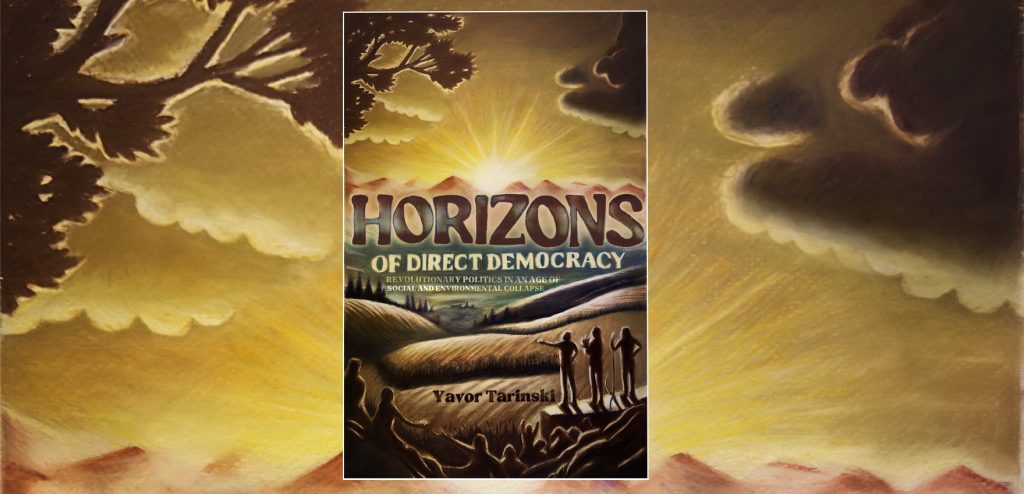
Dr. Eleanor Finley reviews Yavor Tarinski’s latest book Horizons of Direct Democracy: Revolutionary Politics in an Age of Social & Environmental Collapse (On Our Own Authority! Publishing, 2025).
It is no secret that our current global order is in chaos. From the global scale to the local, critical social, economic, and political systems are breaking down, both compelling and compelled by ecological collapse. These breakdowns translate to struggle and crisis for the vast majority of people on Earth. Today, millions of people in even ostensibly well-off nations are losing access to social safety nets, education, and opportunities, and even basic goods and services like food, housing, and healthcare. At the same time, these very same “crises” continually serve to boost the already unimaginably gigantic fortunes of billionaires. For a tiny handful of the ultra-rich, societal breakdown is a market opportunity.
Surely, then, there is no better time for moral, life-loving people of conscience to revisit the question of revolution. Historically, the revolutionary project has led committed Leftists to overthrow colonial empires, tear down aristocracies, and raise living standards for common people. It has generated the notion of a society where everyone’s basic needs are met, where individuals are free to pursue their creative talents and passions, and where the collective energy of society is directed toward the common good; it has given generations of ordinary people hope. Sadly, however, that tradition seems to have lost its direction. In the last century and a half, Karl Marx’s ostensibly “scientific” prediction of a global working-class victory over capitalism failed to materialize. From that vacuum, unprincipled, pronationalist “tankie” politics have taken over, driving energy toward reactionary “anti-imperialism” and naive support for non-Western dictators and authoritarian regimes. One might hope that the liberal establishment might move in a more sensible direction, but here too we find cynical careerism, piecemeal reform, and small-minded focus on economy at the expense of politics—the only activity which can really yield a collective, coherent, and liberatory paradigm. Indeed, here in the United States, the closest thing to a serious “revolutionary” program has emanated from the far right. Drawing many maneuvers from the Leftist playbook, neo-fascists spent the last decades patiently calculating its seizure of the U.S. federal government in order to dismantle it from the inside. In 2017, Nazi strategist Steve Banon even went as far as to describe himself as a “Leninist.”
For all this and more, Yavor Tarinski is extremely timely in this urgent, rigorous, and ambitious exploration of democratic revolution in the twenty first century. Drawing on a truly rich array of examples, historical lessons, and practical cases, he illuminates how authority can be equitably shared and collectively managed, ensuring that no realm of society is elevated above others. In doing so, he skillfully navigates away from naïve concepts that imagine a society free from authority, which he aptly terms an “anti-political” society. Politics, rather, becomes a matter of collective societal management, impacting every facet of our shared existence, from ecology to education and healthcare.
One of the book’s many strengths is its theoretical acuity. It is rich with quotes and references, fluently weaving the voices of thinkers such as C.L.R. James, Hannah Arendt, Rosa Luxembourg, Murray Bookchin, and folks like Fredrich Nietzsche or Sigmund Freud. This book is especially important for its insight into the ideas of Greek revolutionary Cornelius Castoriadis, a contemporary of Bookchin whose works are little known and under-appreciated in the Anglophone sphere.
Yet for all that this book bears in theoretical weight, it does so in the service of practical concerns. The book is structured to bear down on the critical issues facing our society today—climate change, decolonization, urban poverty and displacement, etc.—and carefully explains how a directly democratic politics can be used to solve them. I reached out to Yavor to gain deeper insight into his goals and inspirations for writing the manuscript, to which he candidly replied, “I always intend my writings as another form of political action. This one is no different. As a manual laborer, I do not write for academia, though I may sometimes adopt a scholarly style.” Again, he makes visible under-appreciated movement history, such as the autonomist tradition in his native Bulgaria.
Tarinski’s clarity of purpose and commitment to political effectiveness comes through not only in the text, but also in the publishing process. On Our Own Authority!—a collective press halfway across the world from Tarinski’s home in Athens, Greece—has been instrumental in highlighting the significance of direct democracy to readers in North America. This collaborative effort, uniting an Eastern European Balkanite with comrades from the United States, speaks to the emergence of a relatively more open, non-dogmatic approach to directly democratic politics—a departure from the competitive and polemical habits of previous generations. The book’s final section features a lively conversation between Tarinski and Black revolutionary Modibo Kadalie and fascinating collective reflection on the fraught legacy of ancient Greece.
So, what does “revolution” really mean in the twenty-first century? Ultimately, the answer belongs to the multitudes, and is beyond the capacities of any single author. No doubt, within those multitudes we will find disagreement about what kinds of efforts count as truly “democratic.” But, with any luck, that movement of movements will be largely on board with Tarinski’s prescription to restructure power dynamics and create entirely new political institutions, thoroughly altering the political architecture of society. And, as is evident in the book, we must do so in a spirit of openness and non-dogmatism, embracing internationalism, humanism, and non-hierarchy. Only through these ideals can we take the present chaos and fashion a future worth living.
Leave a Reply