
Political-analytical outlook on Iran from an anarchist perspective
Written by Hasse-Nima Golkar. Original publication in Persian at the Anarchist Front website.
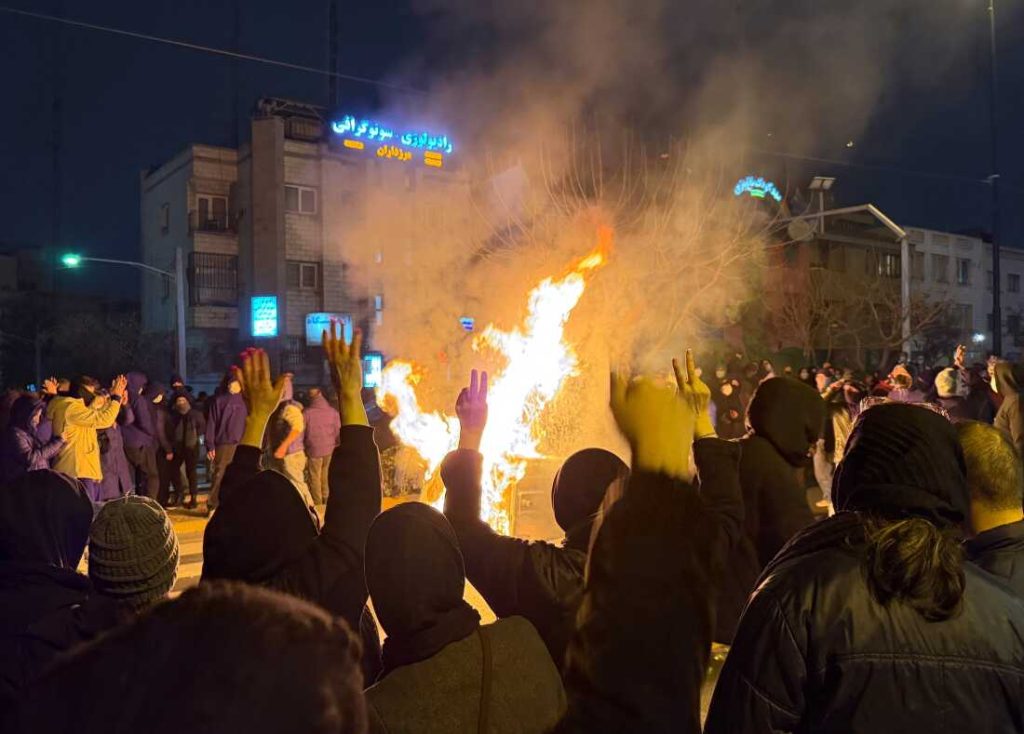
The revolutionary movement of the Iranian people, which began again on December 28, 2025, was met with incredible violence by the Islamic-fascist government that rules over the geography of Iran. It is said that this horrific crime has left at least 12,000 adults and children dead so far, and it is likely that the number of dead is much higher.
The reality is that, on the one hand, defenseless people will not be able to fight this regime with their bare hands, armed to the teeth, and on the other hand, the leftist political forces, due to the very rapid and growing pace of the current revolutionary movement, have lagged far behind in the radical and practical organization of the working class and other oppressed social layers, and unfortunately, they have not been able to do anything effective so far.
Right-wing political forces, especially the authoritarians and followers of the violent and fascist “Reza Pahlavi”, have become very active, and in order to come to power, it is possible that, on the one hand, they will form an alliance with a part of the army – the reformist section of the Revolutionary Guards – and on the other hand, they will succeed in “overthrowing” the Islamic Republic by obtaining political and military assistance from Western forces, including the United States, Israel, and some European governments.
Of course, we know that very complex conditions prevail in the Middle East region, including Iran, and the possibility of predicting the future is close to zero or very difficult. However, with the data that exists so far, is it possible to speculate on the following: 1- Will a war by the United States and Israel against the Islamic State occur? 2- Is a vision for the political future of Iran and the Middle East conceivable?
Regarding the nationwide protest movement in Iran, numerous reports and analyses have been published that give us a clearer perspective on the current situation and future possibilities — however, it is almost impossible to make an accurate prediction about the future of Iran and the Middle East region at this point.
1- The reality of the situation of protests and repression
Nationwide protests began in late December 2025 and have so far covered all 31 provinces, facing severe security-military violence in some areas.
International and social media have reported several thousand deaths, between 3,000 and 15,000 people (adults and children) and tens of thousands of arrests. However, exact figures remain uncertain and impossible to obtain due to a complete internet shutdown, severe censorship, and inconsistent information; although efforts are being made to disseminate information via satellite communications.
The Iranian government has so far continued to use extremely harsh repression, including direct fire, the use of live ammunition, and a program of summary trials and executions, accusing protesters of being “terrorists” and accusing them of foreign interference.
In addition to widespread economic and political protests, news reports show severe injuries, including eye and head injuries from live and pellet bullets.
2- The possibility of military intervention by the US and Israel
To date, there has been no major US or Israeli military strike against Iran’s rulers. However, US President Donald Trump has warned that “stronger action” may be taken if the killings/executions or severe repression continue.
Some analysts indicate that military options, cyber measures, economic pressure, or indirect tools are under discussion, but no definitive decision for a direct attack has yet been announced.
European countries and allies of the United States have generally rejected or cautiously mentioned direct militarization, relying more on sanctions and political pressure.
In contrast, the Iranian government has threatened to respond to American and Israeli forces and interests in the event of an attack.
As a result, the possibility of a direct US/Israeli war against the “Islamic Republic”, although possible, is not certain at this point and has been discussed mostly in terms of threat levels, scenarios of maximum and extensive economic pressure, and indirect military options.
3- Iran’s political outlook from the perspective of current developments
At this point, there are several potential scenarios, none of which are definitive:
A) The continuation of the crisis and military-security repression
The Iranian government, with the help of security forces including the Islamic Revolutionary Guard Corps and the Basij, may largely quell the protests, albeit at great human and political cost. And continued internet and telephone blackouts (most of the time), repression, and international pressure could fuel the unrest for a while.
B) Political crisis and the slow and gradual collapse of the system
If more serious divisions emerge within the security forces or among the ruling elite, the crisis could lead to a structural failure of the system of government, something analysts consider likely, but not certain.
C) The role of foreign actors
Direct military intervention is unlikely, but economic pressure, sanctions, diplomatic efforts, and media support could play a decisive role.
“Political support” from some governments (including the United States or Israel) for the protests can have an impact on putting pressure on the government, but it does not necessarily lead to an immediate change of power.
4- Iran’s political landscape
Various social movements with horizontal structures (without party hierarchy) are still not seen in the form of self-organization and self-management of the working class (whether in production, services, etc.). Protests are still based more on local gatherings and scattered street protests, rather than industrial factory strikes.
If these types of movements want and are willing to act for structural change, they will necessarily need to build stronger local and regional networks of trade unions and democratic and horizontal self-management councils, so that they can undertake practical projects for governing the post-crisis society. Without such pre-formed institutions, any movement may quickly decline or drift towards right-wing political actors.
In general, any revolutionary transformation and the emergence of new social movements will not achieve the desired result and definitive and final victory without collective horizontal structures and stable communication networks, especially considering the complex role of external powers and the internal security structure.
5- Possible short-term and medium-term scenarios
Based on available data and without making any definitive predictive claims, scenarios can be divided into three time horizons (short-term, medium-term, long-term) and three levels: political, economic, and social.
A) Political in the short term
– Dominant scenario: continued repression + maneuvering by foreign powers.
– The government is trying to wear down and wear down the movement with naked violence (arrests, torture, televised confessions and executions, a kind of hidden martial law and the cutting off of communications).
– The rift at the top of the power pyramid has not yet reached the point of collapse.
– Due to the inability of anarchist and leftist forces to organize and exert influence; right-wing forces (monarchists, military nationalists, liberals affiliated with the Western capitalist system) will be the most active organized forces abroad and, to some extent, inside the country and will demonstrate power.
– The likelihood of a direct military attack by the US and Israel is low (but possible), proxy war, cyber warfare, targeted assassinations, economic pressure, and information support for the right-wing opposition are likely.
– The main danger at this stage is the “stealing of the revolution” by fascist and authoritarian forces, whether in the form of “savior” military forces, Reza Pahlavi, or some kind of technocratic interim government.
B) Economic in the short run
– Paralysis of the production chain, scattered labor strikes, further collapse of the value of the currency, energy and food shortages in some regions.
– Anarchist potentials:
the beginning of the creation of self-help cells, local distribution of food and medicine, neighborhood mutual assistance networks for survival and not for the management of society.
C) Social in the short term
– Radicalization of the masses.
– The collapse of the complete moral acceptability of the “Islamic Republic.”
– Expanding horizontal solidarity in the family, neighborhood, educational and work environments, without the existence of a nationwide network of self-government and sustainable councils.
B – Political in the medium term
Three possible paths:
Route 1
– Collapse/overthrow from above, coalition of monarchists with part of the Revolutionary Guards, the army, and Western support.
– Formation of an authoritarian transitional government.
– Reproduction of the capitalist system: state, parliament, nationalism, security-military police
– Severe repression of anarchists and all opposition leftist forces under the name of “establishing order.”
Route 2
Syrianized stalemate:
– Practical disintegration of paramilitary groups
– Regional intervention
– Human disaster
Route 3
The expansion of mass self-organization and self-management (unlikely but historically), the creation of horizontal federalist networks by forming democratic councils in neighborhoods, factories, and educational centers.
C) Economy in the medium term
– Neoliberal privatization with an iron fist, or the war-rent economy.
– In the liberating scenario: expropriation of large capitals, cooperative economy and council management of production.
C) Social in the medium term
– National identity crisis.
– The issue of federalism and ethnicities.
– The role of women and the younger generation in redefining power relations.
– The possibility of the growth of right-wing militias or the formation of popular councils.
From an anarchist perspective, the real battle is not just with the ruling regime, but with the very concept of the nation-state, borders, army, leader, and everything that is sacred.
6- Possible long-term scenarios at the regional level (Middle East) with three perspectives:
A) The new imperialist order
– Israeli military hegemony
– Arab security states
– Post-Islamic but militaristic-nationalist Iran
– Victimization of the working class, ethnic and sexual minorities, refugees.
B) Seasonal chaos
– Consecutive civil wars.
– Failed governments.
– Military-religious mafias
C) The liberating horizon (anarchist-confederalist) inspired by:
– Communes of Rojava (north and east of Syria).
– People’s libertarian federalism.
– Workers’ councils and…
– Collaborative and cooperative economy.
– Abolition of the nation-state.
– Abolition of the standing army.
– Gender equality.
– Environmental self-management.
As a result:
– Iran will be without a centralized government, and a network of communes, democratic councils, and free confederations.
– Borders are softening.
– Military forces give way to popular defense.
– Large capitals become social.
Religion and the state are completely removed from socio-political power.
7- Anarcho-syndicalist Conclusion
The issue is not just the “fall of the Islamic Republic,” but the main issue is whether the historical cycle of new repression > new government > revolution > government
will be broken or not?
Because if: real councils are not formed, weapons for self-defense are not organized in the hands of the people, the economy is not self-governing, politics is not horizontal; then even if the “Islamic Republic” falls, only tyranny and exploitation will change cover.
But if: horizontal solidarity networks, federation of councils, self-management of production, and anti-authoritarian culture grow and develop; then within this same catastrophe, an embryo of a stateless, leaderless, armyless, capitalistless, and patriarchal Iran can be born.
In closing: Let us remember that in such a painful and turbulent time, collective thinking and radical criticism of authority is itself a form of anarchist resistance.
Leave a Reply