
The Significance of Spatiality in Bookchin’s Political Project
Speech delivered by Yavor Tarinski at the International Tribute to Murray Bookchin, 30 July 2026, organised by the Netzwerk für Kommunalismus.
It is a great pleasure to have been invited to take part in this international commemorative tribute, dedicated to the 20th anniversary of the death of Murray Bookchin. I was born and raised in Bulgaria, a post-socialist country that was once part of the Warsaw Pact and the Eastern Bloc. When the state communist project failed throughout the countries of Eastern Europe, the mass of people in the region hoped for a democratic future. But the liberal order that came after was oligarchic in its essence, retaining power in the hands of narrow political elites. The introduction of electoral processes, while putting an end to totalitarianism, were unaible to give power to the people. With the time I discovered voices from around the world who took democracy seriously – voices that belonged to people like Cornelius Castoriadis, Hannah Arendt, and of course, Murray Bookchin. They realized that real popular participation could not come through occasional ritualistic elections, but require a dimension of unmediated grassroots politics.
I think that one thing that characterizes Bookchin’s work is its potency to inspire political action: his influence can be felt in environmental movements, urban citizen initiatives, and even the Rojava revolution in the Middle East. And I would argue that one aspect of his thought that contributes greatly to this potency is the central role the thinker dedicates to spatiality.
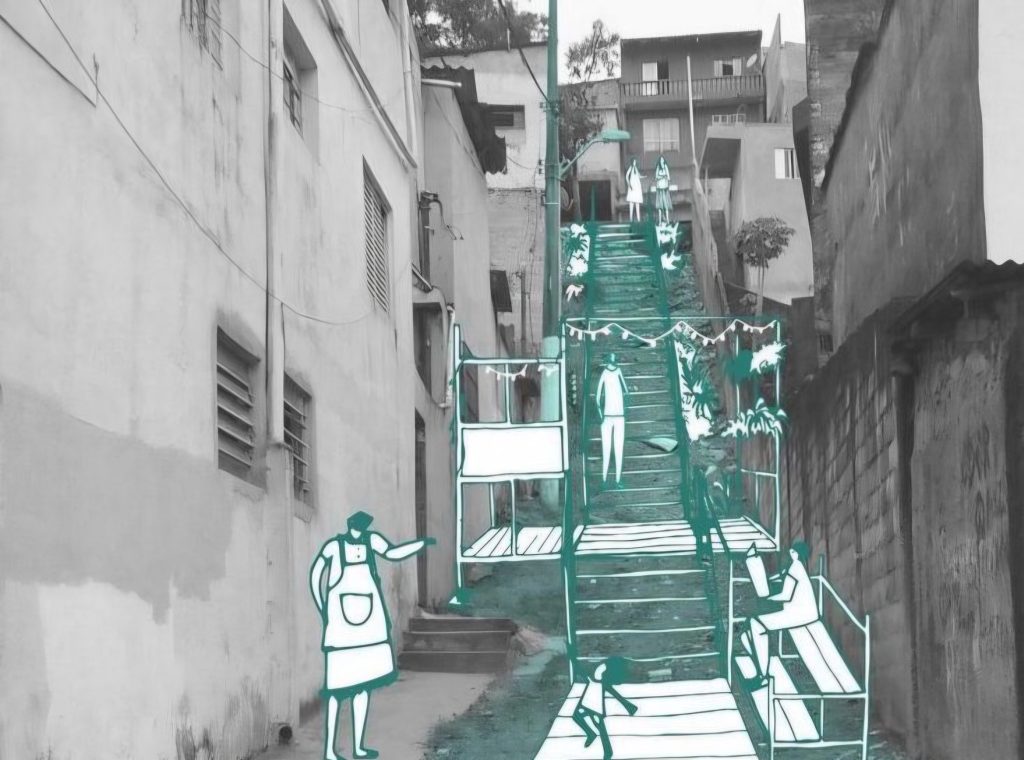
There is a trait in radical thought and practice throughout history that focuses on space as crucial for the question of social organization. From Pierre-Joseph Proudhon and William Morris, through Pyotr Kropotkin and Elise Reclus, to Henri Lefebvre and Murray Bookchin, there is this libertarian tradition that suggests that political participation cannot be excercized in a void or on an abstract level. There must be a space that is being collectively experienced and cared for by those that inhabit it. For Bookchin, like many of his predecessors, this place was the municipality as a shared political environment that binds people via collectively-forged social contract.
The focus on the spatial dimension of politics ultimately centers on the everyday life of each and every individual member of society. The municipality, unlike the State, offers an inherently humane level, prone to direct and unmediated management by the citizenry. Bookchin insisted that citizenship cannot be separated from a spatial dimension that allows people to act as citizens – i.e. to directly participate in collective decision-making. Without such a space, one can be citizen only in name but not in content. Referendums and various digital tools, while surely helpful, can never be the basis of a direct democracy as they do not provide democratic spatialtiy but only a belonging to an abstract whole.
For this reason Bookchin advanced the institutions of the face-to-face assembly and the council of revocable delegates as proper spaces on which a genuine direct democracy can be built upon. But as the sagacious thinker that he was, he foresaw that enclosing ourselves into our communities will lead to nothing but parochial localism. So he insisted that we should actively seek to link our municipalities into democratic confederations that allow for power and knowledge to flow horizontally, thus avoiding the danger of the emergence of new ruling castes. Such democratic spaces are also places that offer a real paidia, or civic education, that creates an anthropological type that is passionate for political participation and takes responsibility for their actions and those of their community.
By pointing at our lived environments as the proper spaces on which a coherent direct-democratic system could be built, Bookchin also underlined at the inherent interconnectedness betwenn democracy and ecology. The quality of life it is not only determined by the towns and cities we built, but also by the natural world that surrounds us. Unlike political and business elites that have the privilege of deciding the fate of far-away places, grassroots communities often have to act as conscious stewards of their direct surrounding natural environent as their everyday life depends on it. Because of this interconnectedness Bookchin insisted that the ecological crises of our time stem from instituted social hierarchies, and if we are to resolve the former we will have to replace the latter with a non-hierarchic alternative.
The spatiality in Bookchin’s political project is so potent in provoking grassroots action first and foremost, because this humane and communal dimension that we find throughout his body of work is inherent to every human society. It is a call to action to everyone everywhere and a powerful reminder that a truly democratic and ecological civilization is not only possible, but it is up to each and every one of us.
Leave a Reply