
Bookchin’s Living Legacy: from Social Ecology to Culture(s) of Resistance
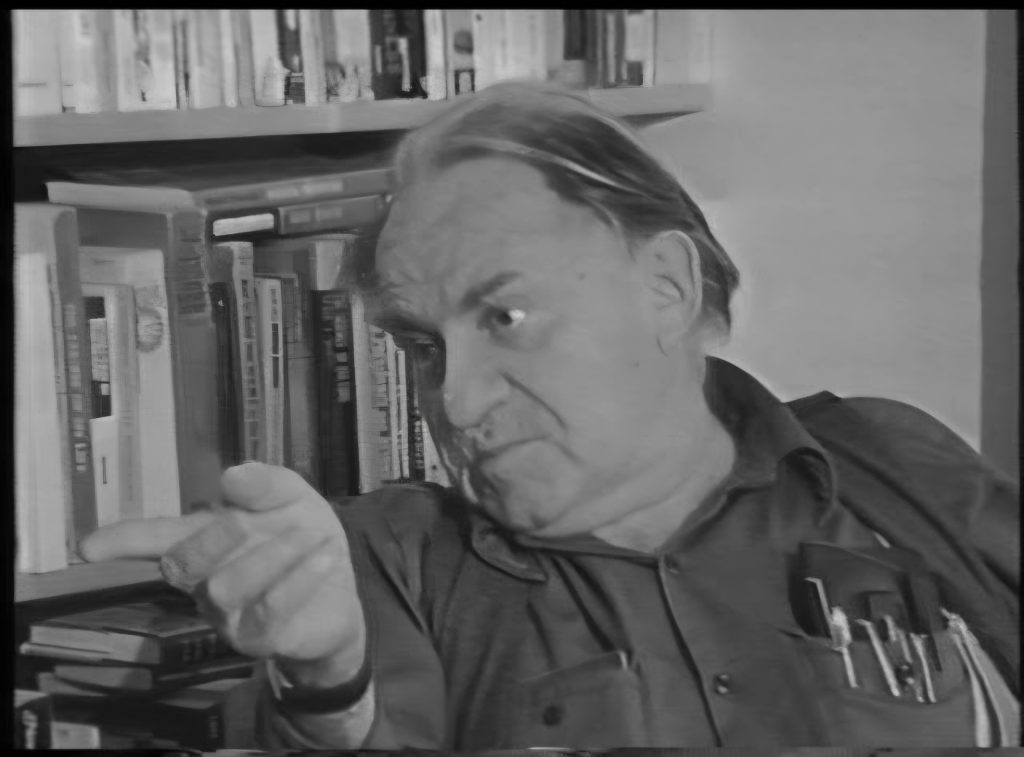
Speech delivered by Federico Venturini at the International Tribute to Murray Bookchin, 30 July 2026, organised by the Netzwerk für Kommunalismus.
I am very pleased and honoured to take part in this international tribute to Murray Bookchin on the twentieth anniversary of his death. I never had the pleasure of meeting Murray in person and I began my political activism in my late teens, shortly after the 2001 G8 summit in Genoa, in an anarchist social centre in Udine (Italy). It was a space shaped by social ecology, punk concerts, and everyday collective practices, a combination that Murray might perhaps have found surprising. It was there that I was first introduced to social ecology, which gradually became a central pillar of my life and activism. Years later, I helped to establish the Transnational Institute of Social Ecology – TRISE based in Europe.
Murray was right to warn that capitalist and hierarchical interventions in the natural world were disrupting ecological processes. This disruption extends beyond climate change to biodiversity loss, the alteration of water and nutrient cycles, and the spread of synthetic pollutants across the planet. As Bookchin anticipated, we are now living through a polycrisis marked by ecological breakdown, social fragmentation, widening inequality, war, and an authoritarian resurgence. Thesecrises are intensified by the capitalist mode of production, which now shapes virtually every sphere of social life across the globe. Although this diagnosis might once have appeared exaggerated or excessively harsh, it is now increasingly difficult to deny. Its consequences are neither abstract nor distant: they are inscribed in our everyday lives, in our cities, in our relationships, and in the air we breathe.
I believe that the relevance of Murray Bookchin’s contribution lies in four interconnected dimensions that are too often treated separately: analysis, ethics, praxis, and political vision. Social ecology provides a starting point for analysing contemporary crises; an ethical foundation for social transformation through dialectical naturalism; a practical orientation for change through praxis; and a political horizon through its eutopian project.
Its analytical contribution begins by showing that ecological destruction cannot be separated from hierarchy, domination, exploitation, and the capitalist organisation of society. Environmental and social crises are not isolated problems, but interconnected expressions of the same structures of power.
Through dialectical naturalism, social ecology provides a reconstructive ethics for social transformation. It understands nature and society as evolutionary processes containing unrealised potentialities. Cooperation, mutual aid, unity in diversity, rationality, and freedom are therefore not merely abstract ideals, but possibilities that can be consciously developed through human action. Social ecology then translates this ethical commitment into praxis through direct action, popular assemblies, direct democracy, confederation, and the communal management of economic life.
These practices do not merely resist existing institutions; they allow people to recover their collective agency and begin constructing alternative forms of power.
Finally, social ecology offers a eutopian horizon: not an abstract or perfect society, but the concrete construction of good places based on ecological balance, decentralisation, material sufficiency, participatory democracy, and the fuller development of human and natural potentialities.
What, then, should we do with the knowledge accumulated through decades of work? We should continue to develop and revise it, learning from past mistakes and from new experiences. In particular, we should learn from the Zapatistas and the Kurdish freedom movement, alongside many other struggles, as we continue to build cultures of resistance. These experiences should not be treated as models to be copied, but as situated experiments that have critically reworked earlier traditions in response to specific historical and geographical conditions. Their importance lies in their capacity to translate radical ideas into forms of organisation, language, and practice rooted in people’s everyday lives.
We should continually discover, engage with, and transform this body of knowledge, keeping it dynamic and avoiding the danger of ossified theorisation against which Murray Bookchin repeatedly warned. Knowledge must remain relevant, useful, and, above all, accessible to social movements committed to social transformation.
Our continuing responsibility within social ecology is therefore to research, teach, and organise for just and ecologically sustainable futures. This is how we can honour Bookchin: not by preserving his work unchanged, but by keeping its revolutionary possibilities alive.
Leave a Reply