
The Serbian Student Movement: From Student Plenums to Collective Power
Written by anthropologist Katarina Milutinović.
Many international friends have been asking me so many thoughtful questions about what’s happening in Serbia, so I tried to gather everything in a more or less small summary in here, from my own perspective and experience.
This is of course not the whole picture tho, so if something is unclear, or you just want to dig deeper, please keep asking. I really love those questions, and I’m always happy to talk and hear different opinions- thank you for that!
It starts somewhat like this.
As you most likely know, it has been two years since the canopy at the railway station in Novi Sad collapsed and killed 16 people. This tragedy set off a wave of anger and revolt across the country, and out of that anger grew one of the largest student movements the region has seen, one built on grassroots, direct democracy principles.
The greatest spark came when police attacked students and professors from the Faculty of Dramatic Arts while they were commemorating the victims. Within a very short time, universities everywhere were blocked and organised into plenums. Students split into working groups, and delegates carried decisions between those groups and the other plenums, which together formed a network across the whole country. None of these methods is new, but the scale and staying power of this movement are.
This has changed, and continues to do so, the political narative of Serbia. The student body became the strongest political force in the country by setting aside professional politicians from both the government and the opposition, and by making room for ordinary people to be heard. The students walked from town to town, village to village, and the movement soon spread into neighbourhood assemblies.
This way of organising did not come from nowhere.
It grew out of earlier student activism, especially the blockades and plenums of years past, and the Faculty of Philosophy in Belgrade played a key part in that story. Many student uprisings have begun there, and the faculty has always, in fact, leaned left. So in June 1968, during the wave of student protests, students occupied the university and, led by those from the Faculty of Philosophy, renamed the whole University of Belgrade the “Red Karl Marx University.”
Another important influence was the 2009 blockade of the Faculty of Humanities and Social Sciences in Zagreb, which brought us the “Blockade Cookbook” (made by Croatian anarchists). Part manifesto and part case study, it breaks the method down into plenums, working groups, their roles, and delegates. The cookbook reached Serbian universities, where students at the faculties of philosophy and philology kept using this method as it was. In 2011 they fought for free education under the slogan “Znanje nije roba” (“Knowledge is not a commodity”), and in 2014 and 2015 they protested rising education costs, cuts to scholarships, and the poor state of public universities.
Behind all of this is a society that has lived through more than 35 years of mafia rule: corruption, crimes without accountability, austerity, in 2 words: capitalist modernity. Countless people have died at their workplaces and in hospitals due to the bad health care conditions, families have lost their homes to gentrification, and the country has suffered ecological disaster. Serbia is rich with natural resources, which has been broadly used by regional powers. Lithium has always been so appealing to Germany and EU, while gold, silver and copper, were reserved for Chinese investors who have started illegal and secretive mining research and actions in Eastern Serbia. Vučić made sure to keep everyone in the region satisfied, while he was terrorising people in Serbia with his imposed mafia regime. Heavy nationalist propaganda has helped keep the nation-state alive and the population quiet. Institutions are in ruins and nobody trusts them anymore, and an estimated two to four million Serbs now live abroad. Perhaps that’s why what people call “voter apathy” feels less like indifference and more like exhaustion, a very reasonable response to a state that shrinks public life into a choice between different styles of management.
When the student movement took off in late 2024, it welcomed everyone, from every part of the political spectrum, from each corner of the country, minorities included.
Plenums and direct democracy are challenging hard to sustain, because it requires a collective thought process, but everyone gets heard, and that is slowly changing the collective mindset. This is a revolutionary moment in Serbian society.
Decisions are collectively made, and despite plenty of difficulty and internal conflicts (which always have to exist in direct democracy), the process points toward emancipatory practice, something that woke up Serbian society from despair, but also from “vote apathy”, since the majority of the people actually voted the grassroots movement, that had started having a great successes, under the parole whose meaning has deeply shaken the power relations between people and the state: “You are not in charge”. (Dedicated to a former president)
However, although “You” represents Aleksandar Vučić, it means the entire regime, the entire state. Student movement decided to run the elections.
The idea of running in elections did not come easily, and it did not come quickly. On 5 May 2025, after long standing internal and external pressure, the students demanded early parliamentary elections, and soon after they announced they would put together their own list. It would not include students. Instead, it would be made up of academics, professionals and other trusted public figures. Not everyone agreed. Within the plenums there were long debates about whether to run at all and whether to join forces with existing parties. In Belgrade, for example, the plenums voted 29 to 5 to demand elections but only 23 to 9 to run their own list. In the end the students formed an independent list, and in June 2025 they published a programme setting out the conditions candidates had to meet. For more than a year, the candidates were chosen the way the movement does everything: through the plenums, with no party leaders deciding behind closed doors. On 6 September 2026, the plenums held the final vote on who could stand. 3 days later, on 9 September, Vučić finally dissolved parliament and called the elections for 25 October, after the government had put the vote off for as long as it could. That same day the list became an official citizens group, and it was submitted to the electoral commission on 14 September. The full list of 250 candidates was presented shortly afterwards, and no one was named as its leader. Therefore, no one could be easily targeted or persecuted, which had been the case with many students and the people who were supported them publicly. (This was followed my massive police repression and violence on the streets, massive arrests, tortures, blackmailing, and a high level of surveillance- with a help of Israeli government).
The students list has won: reimagining the new democracy
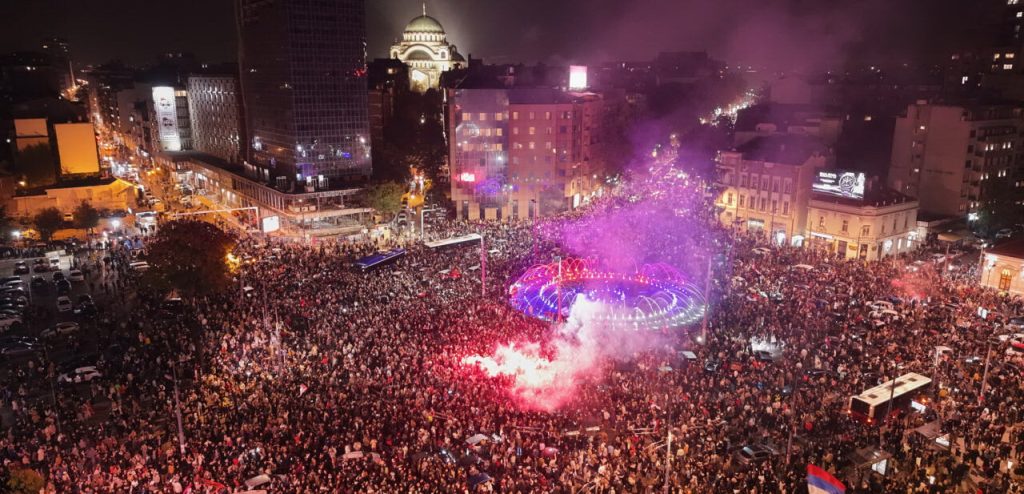
Then the has day come. On 25 October 2026, the Student List won around 52.7 per cent of the vote and roughly 140 of the 250 seats in parliament, enough for an outright majority. Vučić conceded defeat that same night, and the whole country and diaspora celebrated.
What just happened in here, challenges something we’ve been taught for decades: that real democracy means big party machines, elite representatives and charismatic leaders, and that any movement without a visible leader must be messy and can’t last. The students grassroots movement showed otherwise. They built on plenums (open assemblies) where no one is in charge, and instead of career politicians they put trusted experts from civil society on the ballot. In doing so, they proved that a country’s political power can be organised without being concentrated in a few hands.
Their plenums also live out what the anthropologist David Graeber (2004) called prefigurative politics: the way you organise yourselves should already look like the fairer society you want to build.
At the heart of this is a very simple idea: the way our political systems work isn’t a law of nature, this practice comes from contemporary colonial history. It is something people chose and can choose differently. To imagine an egalitarian society, meaning better democracy, we have to stop believing that the state is untouchable. Ordinary people don’t need the blessing of political elites to build the institutions they truly want, and this is how the state capital is being challenged as well.
What has happened in Serbia is only a beginning. The hardest struggle is about to begin.
The movement has to deal with its own internal challenges in keeping emancipatory practices alive within the plenums. It has to face the remains of nationalism (that has also now being deeply challenged through the emancipatory process and direct action), and it has to take on institutions that are still full of remnants of the old mafia regime. And in time it will have to resist pressure from all four geopolitical powers: the EU, the USA, Russia and China.
Critical minds, that are being born again in the past years, and hope will be needed to hold the line. The plenums remain the main carrier of collective emancipatory practice, and they are still here. The grassroots movement stands in the background as a counterweight to parliamentary democracy and nation-state power. If it survives, it will be able to hold every future government to account, because it is a horizontal movement where every voice is heard and acknowledged, something that has been missing since the fall of Yugoslavia.
Leave a Reply