
Interview with András B. Göllner: The Essence and Legacy of the 1956 Hungarian Revolution
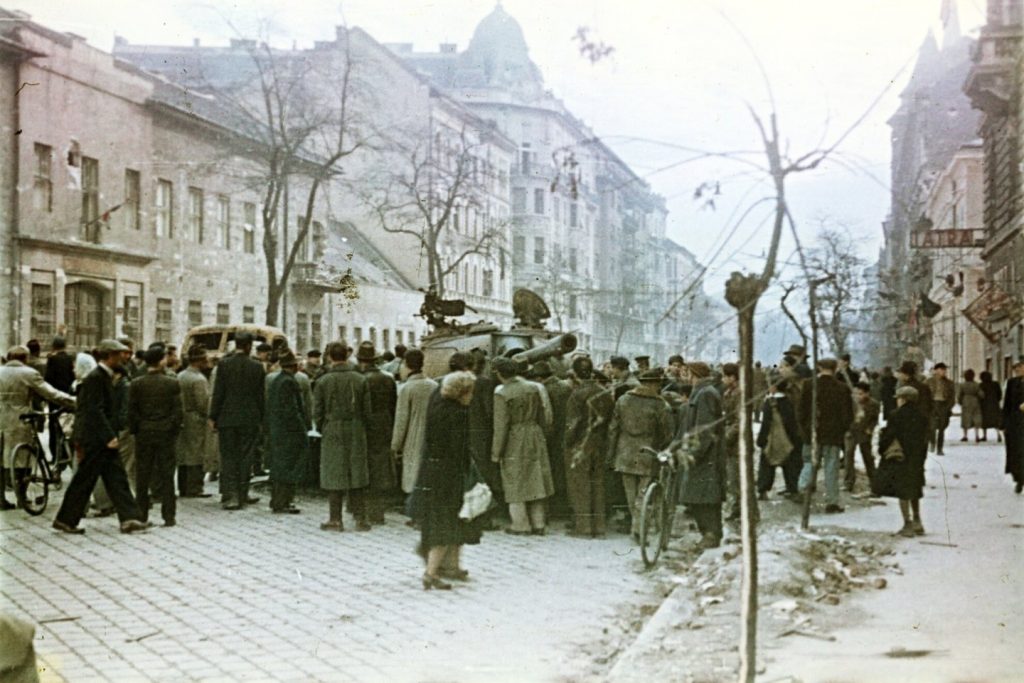
An interview with András B. Göllner, conducted by Yavor Tarinski. Göllner was born in Hungary but resides in Canada. He is an Emeritus Associate Professor of Political Science at Concordia University and an active civil rights advocate. Göllner has authored and edited five books, among which The Forgotten Revolution: The 1919 Hungarian Republic of Councils (Montreal: Black Rose Books, 2022), and his texts have appeared in numerous scholarly journals. The interview is also available in Greek HERE.
A Short History of the 1956 Revolution
Before proceeding with the interview, here is a short historic overview to acquaint the reader with the events at hand. On the 23rd of October 1956, peaceful popular demonstrations erupted in Budapest, Hungary, against the exploitative policies of local authorities and their Soviet masters at the Kremlin. They were inspired by the events in two nearby countries: on the one hand, the workers’ struggles for better living conditions in communist Poland; on the other, by the withdrawal of Soviet troops from neighboring Austria, giving Hungarian people hope that the same might occur in their own country.
The gathered crowds in Budapest, however, were met with fire by state security forces, which led to the death of tens of protesters. This enraged the multitude, which began organising its own revolutionary militias, responding to the attacks on the same day. In the following days the uprising spread throughout all of Hungary, with people establishing in their localities their own units of self-defence and grassroots organs for decision-making in the form of workers councils. Hundreds of such deliberative bodies undertook the self-management of municipalities and workplaces, stripping de facto the State from its functions.
In order to appease popular rage, the ruling party appointed its member Imre Nagy, viewed by most Hungarians at that time as a reformist politician that could deliver more liberties to society. But this move only made people further believe in their own power to enact change, thus fighting and the self-management of everyday life continued for days. Under this popular pressure the Nagy-led government announced Hungary’s exit from the Warsaw Pact (a defence treaty between Soviet Union, Hungary, Albania, Bulgaria, Czechoslovakia, Romania, Poland, and East Germany) and the conduct of free elections.
To this the Soviet leadership responded with sending its army to crush the uprising on 4th of November. The Hungarian people, organised in revolutionary councils and militias, fought off the invasion, but the uprising was finally defeated on 10th of November, although in some parts of the country fighting continued for days on. Around 2000 to 3000 Hungarians and over 700 Soviet troops were killed in the fights, while over 200 000 more Hungarians were forced to seek political refuge abroad.
The Soviets installed new government in Hungary, led by Kremlin loyalist János Kádár. The new government unleashed a wave of arrests. Tens of thousands were sent to prisons and labor camps, and several hundreds were executed, among whom the short-lived Hungarian reformist prime-minister Imre Nagy and renowned Marxist philosopher György Lukács.
In the long term, in order to avoid another such popular uprising, the new government enacted a more relaxed, yet still authoritarian, regime that has come to be known as “goulash communism”, that functioned until the fall of the regime in 1989. The 1956 uprising, on the other hand, remains a stark example of the democratic potential of common people to self-organise and self-manage public affairs. Now we continue with the interview, where the essence and legacy of the revolution are explored in depth.
Yavor Tarinski: To set the scene, what were the socio-political conditions in Hungary leading up to the uprising in October 1956? What made toiling people risk their lives in front of the combined might of the Warsaw Pact?
András B. Göllner: It is important to remember that the Hungarian middle classes, the Hungarian bourgeoisie played only a marginal role in the 1956 uprising. The front lines of this anti-Bolshevik uprising were composed primarily of workers, peasants, their children in the universities, and intellectuals most of whom were the descendants of working class or peasant families.
1956 was not a counterrevolution, an attempt to restore the free movement of capital, the restoration of a free-market, capitalist system. Its aim was to complete the socialist revolution that Hungary’s working classes began in 1919, and which was hijacked from them on two separate occasions. First in 1919 by forces aligned with the western imperialist powers and then in 1948 by the forces of Soviet, Bolshevik imperialism.
From 1948 until October 23, 1956, Hungary’s political-economic system was socialist in name only. Her workers and peasants were the victims of a sham, victims of the worst betrayal of socialist principles anywhere in Europe at that time, The perpetrator of that betrayal were the followers of Lenin and Stalin in the Soviet Union who had outlawed workers self management in the Soviet Union by the spring of 1921 and would crush anyone who attempted to follow that path.
During the interwar years (1920-1945), and following the crushing of her first socialist revolution (March 1919-August 1919) Hungary gradually became a political-economic satellite of Nazi Germany and Fascist Italy. The majority of her major industries were in German Italian hands. Hungary’s armies defended Fascism to the last days of WWII. With the peace agreement, all of the Fascists assets were given to the Soviet Union for 10 years to do as they pleased with, Hungary was occupied by the Red Army, the country was stripped bare of its most vital resources, levied massive reparations payments, and after 1948, when the local Communist Party (led by Stalin’s personal disciples) seized power, the country was put onto a political-economic path that served nothing else than the interests of Soviet, state-owned capital. The only way such a path could be managed was by ruthless repression. (For a detailed account see András B. Göllner, “The Foundations of Soviet Domination and Communist Political Power in Hungary: 1945-1950” in Nándor Dreisziger (ed) The Hungarian Revolution: Twenty Years After, The Canadian American Review of Hungarian Studies III, 2 (1976), 73-105.)
In closing: For a host of reasons, among which the first was the severity of Soviet Imperialistic exploitation, Hungary’s laboring classes took power into their own hands in 1956 because they had enough of the lies, the denial of their dignity, the repression, the hijacking of socialism by a ruthless and dishonest state-capitalist tyrant.
YT: Was there a widespread belief among the general public that meaningful de-Stalinization and democratization could be achieved? Also, was there a particular tendency within the Communist Party that believed that political change can come from within or were their actions a result from the popular pressure from below?
AG: There was widespread belief amongst Hungary’s students and intellectuals at the time that is to say, among those who were active in the uprising that there is a different path to socialism than the one championed by the Bolsheviks in Moscow and Beijing. This path was sketched out to Hungarian socialists by members of the so-called Budapest School of Critical Social Theory as early as the beginning of the 20th century. Many of this first generation of socialists were either anarchists or followers of Rosa Luxemburg by the end of WWI. (This first generation includes thinkers such as Gyorgy Lukacs, Ervin Szabo, Bela Balazs, Karl Polanyi, Carl Mannheim, Ilona Duczynska, its post WWII figures include Istvan Meszaros, Agnes Heller, Istvan Bibo, etc., For my take on all this see Andras B. Gollner. “Workers Against the Bolshevik State: The Budapest School and the 1919 and 1956 Workers’ Rebellions in Hungary” in Marie-Josee Lavalee (ed) Different Shades of Red: Socialisms in 20th Century Europe. Montreal: Black Rose Books, 2026)).
The ideas of the Budapest School would be criminalized by the Kremlin by 1921 and would not be tolerated by the Bolshevik leadership anywhere in their global empire until Mikhael Gorbachev comes on the scene in the mid 1980s. In Hungary, these indigenous early 20th century ideas about workers’ self management, workers councils would resurface with a vengeance both in 1945 and 1956 and were crushed in both cases by the Soviet Red Army.
We need to add: By mid 1950s the Hungarian socialist movement was deeply divided between its indigenous and its externally imposed Bolshevik camps. The former were led by Imre Nagy, the later by Matyas Rakosi, and the availability of choice, the leadership vacuum in the Kremlin following Stalin’s unexpected 1953 passing also had something to do with the October eruption in Hungary.
YT: The Cold War narratives tend to present the uprising of 1956 as a pro-capitalist insurrection, while the then ruling Communist Party elite slandered it as a nationalist counterrevolution. But we know that there was so much more to it than the official lines present. Please, tell us about the emancipatory elements within it, such as the worker councils and the practices of popular self-management that emergent during the days of the uprising of 1956.
AG: Inside Hungary at the time, it was well known that workers councils formed the backbone of the 1956 uprising and that 1956 was not an attempt at capitalist restoration but at altering the relations of Hungary’s workers and peasants to the forces of state capitalist production. It is not a coincidence that NATO forces did not rush to the aid of Hungary’s rebels in 1956. They knew fine well what that revolution was about. By now the history of 1956 has been so greatly distorted – and not only by Western cold-war rhetoricians or by Eastern, Bolshevik historians but also by the scribes of Viktor Orban’s neofascist regime – that few people know what 1956 was really about, even in Hungary. As one of the former members of the Budapest School and a great revolutionary fighter herself put it decades ago: “Workers, sailors, soldiers in revolt do not write, they fight! Almost by necessity their armed struggles later appear distorted in the various high-tension fields of political ideologies” (Ilona Duczynska. Workers in Arms, New York: Monthly Review Press, 1978, pg. 11)
For perhaps the best and truest English language account of the 1956 uprising see Bill Lomax ed., The Hungarian Workers’ Councils in 1956 (New York: East European Monographs, 1990).
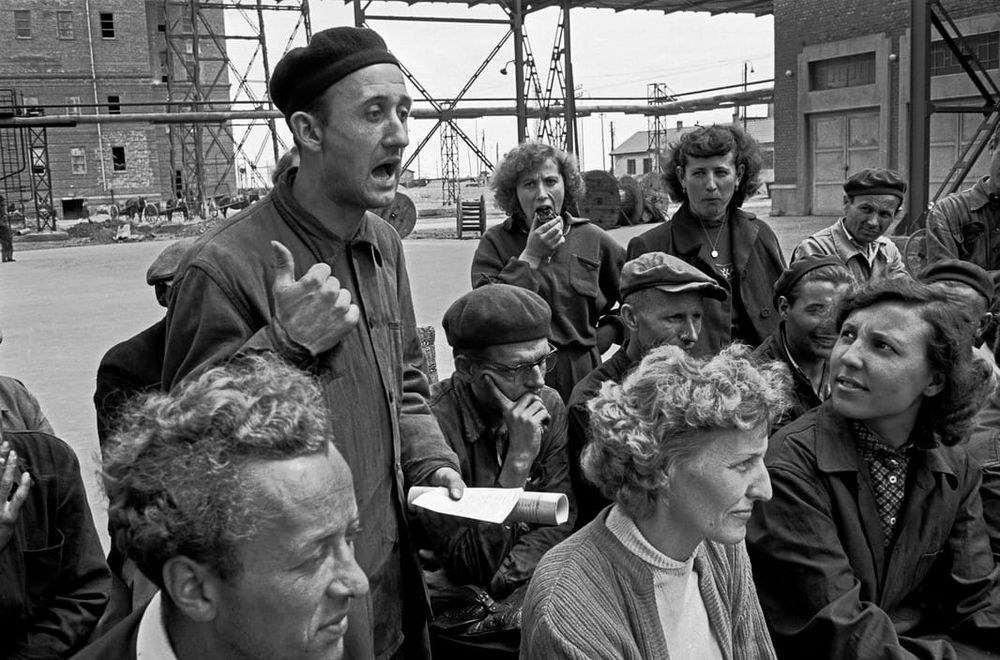
A meeting of the workers’ council at Stalinvarosz steel plant, Dunapentele.
YT: Were there any independent organizations, unions, and/or committees that played significant role in organizing, sustaining, and articulating popular demands, and if yes, which ones could we mention?
AG: The most significant vehicle disseminating the ideas of the Budapest School among Hungary’s working-class students and intellectuals was the Petofi Circle in Budapest. Its meetings were attended by hundreds, the minutes of its meetings were read by tens of thousands throughout the country. The Petofi Circle included among its members such socialist luminaries as Gyorgy Lukacs, Istvan Meszaros, Istvan Bibo, Agnes Heller and many others. Workers Councils sprung up immediately and spontaneously at the outset of the rebellion, taking over the management of State-owned enterprises. The most important of these Councils was the one for Greater Budapest, many of whose members and leaders were either executed or given long prison sentences after tanks of the Soviet Red Army moved into Hungary on November 4th to crush the rebellion – and largely at the instigation of Chairman Mao of China.
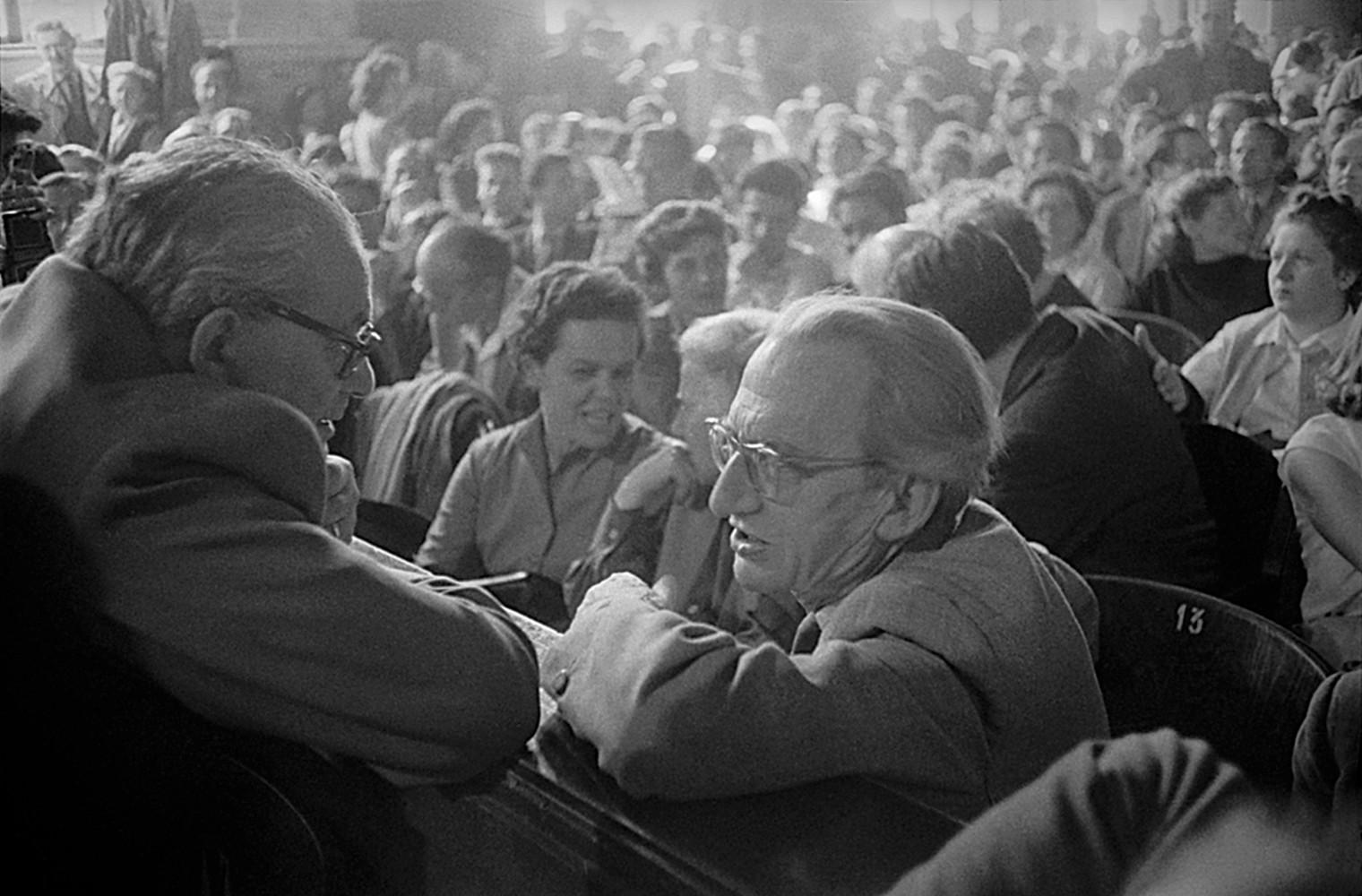
At the meeting of the Petofi Cercle on June 27,1956, Arpad Szakasits talks to philosopher George Lukacs.
YT: What was the reaction by the Soviet Union to the 1956 uprising during these days?
AG: The new post-Stalinist leadership in the Kremlin was taken off guard and was briefly paralyzed. Public discourse in the Soviet Union was tightly controlled; we do not have well documented accounts either about the deliberations amongst the Soviet leaders or about public opinion at large. It is well known however that the leadership of the Chinese CP was adamant, that Hungary’s workers be crushed without any mercy because if they got away with their uprising, it could topple the Bolsheviks’ global empire. This spurred on the Soviet “tankist” reaction to the rebels. The Soviet press reported upon the official Kremlin line, in a few places there were faint and sporadic expressions of solidarity, but these were quickly extinguished. The best reflection upon all this, and upon how the Communist Parties in the West reacted to Hungary’s working class rebellion is by Istvan Meszaros, a globally acknowledged member of the Budapest School of Critical Social Theory: “Having directly experienced Stalinist rule and the bloody suppression of the 1956 uprising in Hungary by the Red Army (applauded, to their indelible shame, by the Communist parties in the West), it became clear to me not only that the proclaimed end of alienation in the East was a fairy-tale, but also that the existing Soviet system had nothing whatsoever to do with socialism… One could only remain a socialist despite and not because of the Soviet Union.” (István Mészáros from Beyond Capital)
YT: Can you speak to us also about the aftermath of the uprising: what was the level of repression that was unleashed upon the population, how was the communist regime shaped by these events, what policies it enacted in regard to society?
AG: Between two and three thousand people were executed, and 20,000 were given lengthy prison sentences. The Kremlin installed a new puppet, Janos Kadar, to the head up the Hungarian communist party, and a period of heavy repression followed suit. The Kremlin leadership recognized however, and already under the leadership of Nikita Khrushchev that its excessive extractive pressures on Hungary’s workers could backfire, and gave considerable leeway within the Bolshevik guardrails to Kadar to govern Hungary in a manner that would be less revolting to its inhabitants. A series of amnesties were introduced during the early 1960s and under Kadar, Hungary came to be known for its more liberal, “Gulyas Communism” Make no mistake about it: Kadar kept Hungary well within the Bolshevik guidelines, and the following quotation from Bill Lomax, clearly describes the situation in Hungary up to the fall of the Berlin Wall:
(Under Kadar) Hungary travelled far from the Stalinist state it was before 1956… it is no longer a totalitarian society… it is (however) still a police state of arbitrary rule…The Kádár regime presents its human face to those who pIease it. The opportunist, the careerist, the conformist and the coward has now learned how best to work the system, how to gain the benefits and privileges that the regime is prepared to hand down to those prepared to play the game according to its rules… But those who are not prepared to abandon their self-respect, their personal integrity and moral values, or their solidarity with their fellow men and women, those who seek to lead a life of their own making and deny the conduct of self-alienation demanded by the state, or those whom for whatever reason of its own choosing the regime decides not to smile upon, they can be denied all rights and find themselves faced with the total and arbitrary powers of the monolithic police state”. (Bill Lomax. ’25 Years Later-New Light on 1956′, The Socialist Register: Labour Focus on Eastern Europe 5, no. 3, (Summer 1982).
YT: Finally, how are the events of 1956 perceived nowadays in Hungarian society? What is the official State narrative, but also how other political tendencies try to appropriate its legacy?
AG: The quotation from Ilona Duczynska above is apposite. Contemporary Hungary’s take largely coincides with the conventional liberal-democratic Western take on 1956. By and large, most Hungarians look upon 1956 as a heroic nationwide attempt to stand up to an imperialist bully that attempted to exploit them. The role of workers and peasants and their aspirations for a non-capitalist, socialist future, governed from the bottom up by their own freely formed councils has been largely erased from collective memory. MOST Hungarians look at the actions of their ancestors 70 years ago as a brave, heroic attempt to rejoin the Christian, liberal-democratic, pluralist European West. Sadly, and thanks to socialism’s Bolshevik hijackers and to Hungary’s home-grown liberal, conservative scribes, Hungarians look upon socialism today as an alien, non-Christian, repressive form of governance. Most of them would not know the difference between council and national socialism and would look upon workers’ councils not as the essence of socialist development but as a pie in the sky.
Leave a Reply