
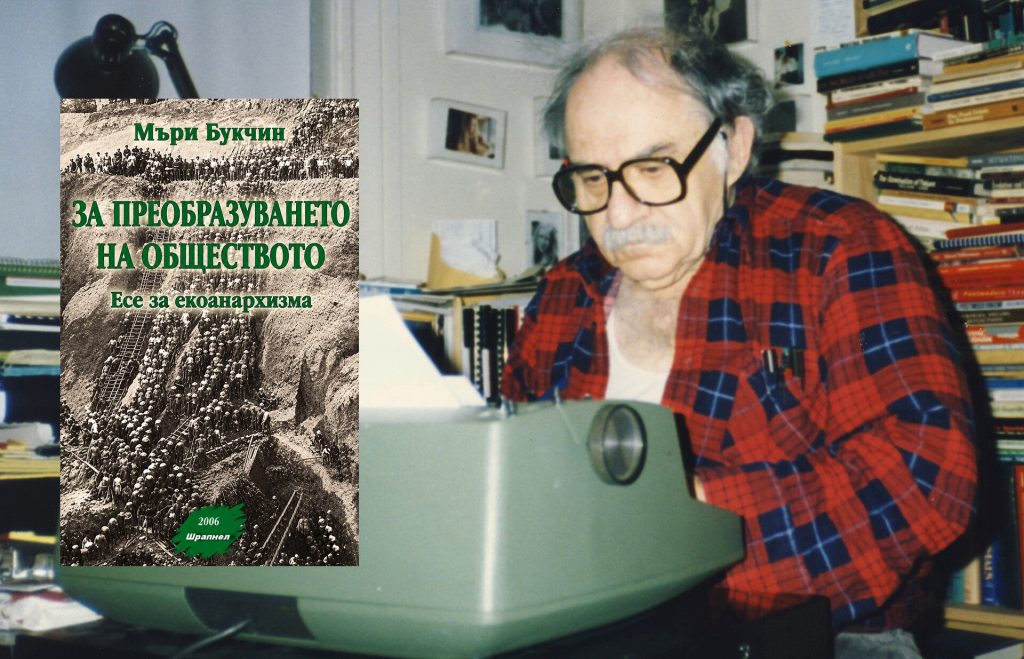
Written by Georgi Konstantinov. Born 1933 in the city of Blagoevgrad, he one of the most prominent figures of contemporary Bulgarian anarchism. He was sentenced to death by the Stalinist regime in the country twice: for bombing Stalin’s statue in Sofia (Bulgaria’s capital) in 1953 and for fleeing the country in 1973, but was granted pardon in both cases. He served 10 years at “Belene” labor camp – one of the most monstrous gulags of Bulgaria’s socialist regime. Nowadays he remains devoted to his radical ideas, and has authored numerous essays and books on anarchism.
“Remaking Society” has been the first (and so far the only) of Bookchin’s books to ever be translated into Bulgarian by the publishing house “Schrapnel” in Sofia, 2006, under the title “On Social Transformation: or Eco-Anarchism.” The following review of Bookchin’s book has appeared on several online bookstores and websites.
The author, who passed away in 2006, is another of many examples for the richness, diversity, and inexhaustibility of anarchist thought. He was the first to draw attention to the decisive role of the ecological factor in the development of humanity. He called on those suffering from land, air, and water pollution to rely on themselves and not on the philanthropy of those who profit on their behalf.
When environmental protection is limited to punctual reforms, its defenders are often left to be tempted by the sirens of electoral and parliamentary activists.
No major changes are needed to transform a lobby into a political party, an eco-reformer into a parliamentarian or a “beggar” into a “prince.” There is a fatally degenerating symbiosis between the one who prays humbly to authority and the one who exercises it arrogantly.
Both share the idea that change is possible only through authority and, more precisely, only through state authority—this professional corps of murderers and thieves, of legislators, bureaucrats, the military and the police, who are themselves corrupted by capital, including in its most mafia form. Every time this authority is appealed to, it comes out stronger and at the same time the people lose their power. The authority that the state wins is won at the expense of the people’s power and vice versa. Any attempt to legitimize the authority of the state means to take away the legitimacy of the people’s power.
The land should no longer be owned, but shared. Its fruits, including those produced by technology and labour, can no longer be appropriated by a few; they must be made accessible to all according to their needs. The opportunity to make decisions must be freed from the control of the elites and redistributed in a form of participation and complicity by all. Until these fundamental problems are resolved, no general interest can be generated to formulate political solutions to an ecological crisis that will continue to worsen in a society incapable of resolving it.
Leave a Reply