
Politics as Everyday Life: Gender, Memory, and Democratic Practice in the Democratic Regions Party (DBP), Amed
Written by Katarina Milutinović and Aisha Mustafayeva
“Têkoşîn ne tenê ji bo azadiyê ye, têkoşîn bixwe azadî ye.”
(“Struggle is not merely for freedom; the struggle itself is freedom.”)
~Sakine Cansız
Arrival in Amed
It was July, and the scorching sun in Amed, the Kurdish name for Diyarbakır (Bakur, Northern Kurdistan). Two of us had arrived earlier this year, on a journey we had long wished to make together. The city’s ancient beauty, the warmth, but also strength and resilience of its people, and the stories they shared with us left a mark, and we knew almost at once that we would have to come back.
Beneath the apparent calm, though, the city was being watched. High military towers fitted with state-of-the-art optics kept an eye on the skyline. Checkpoints guarded every way in, and anyone entering or leaving was asked for identification. On our evening walks, armoured vehicles with snipers mounted on top rolled through the streets, a reminder of how normal militarisation has become here. Kurdish (Kurmancî and Kirmanckî/Zazaki) is spoken, but its public and institutional life is tightly constrained. It survives mostly at home, in grassroots cultural initiatives, and in a few sanctuaries such as local cafés and the Mala Dengbêj, the House of the Bards.
We came to Bakur, the Kurdish north of Turkey, with a lot of questions.
How are autonomous women’s structures holding up, and how do they organise on the ground today? How is political life unfolding after Abdullah Öcalan’s call for peace in February 2025 and the ceasefire that followed? And how have this January’s events in Rojava reshaped the region?
Those events colour everything below. In early January 2026, fighting broke out in Aleppo’s Kurdish neighbourhoods of Sheikh Maqsoud and Ashrafieh between Syrian government forces and forces affiliated with the SDF, and by the end of the month the SDF and Damascus had agreed to a gradual integration of Kurdish military and civilian institutions into the Syrian state. At the same time, peace efforts between the Turkish state and the Kurdish movement had started up again. Both developments press on the movement’s long-standing project: democratic confederalism, women’s liberation (including the feminist science of jineolojî) and social ecology, which together reject the nation-state in favour of grassroots democracy. For two decades that project has anchored the movement across all four parts of Kurdistan: Bakur (North/Turkey), Rojava (West/Syria), Basur (South/Iraq) and Rojhelat (East/Iran).
The movement has adapted to crises before, and through all of them one constant has remained: hope.
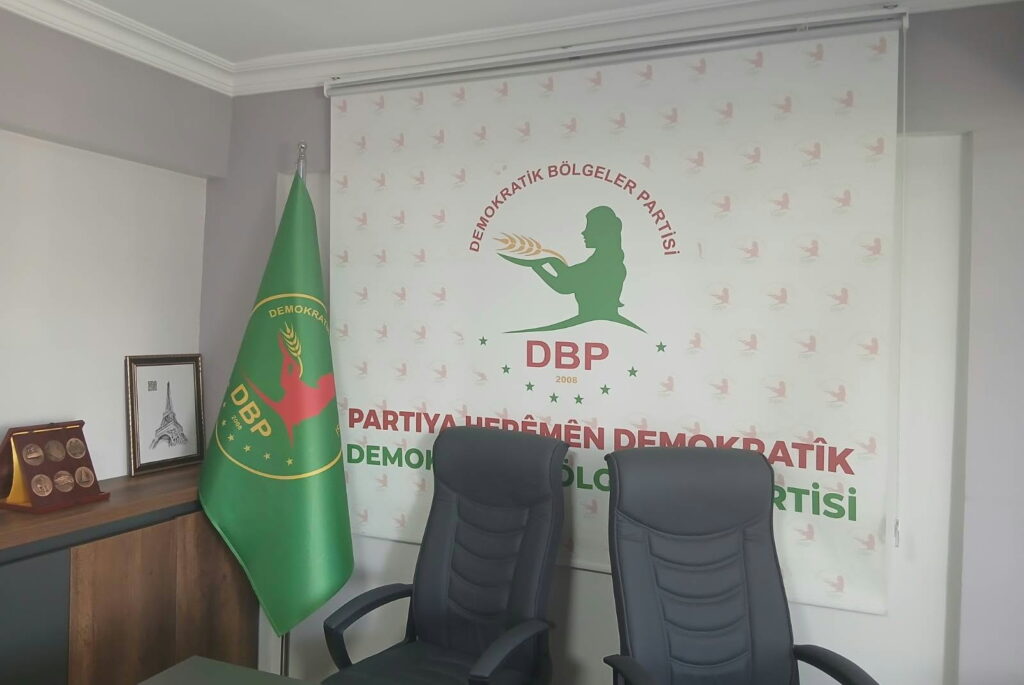
We pursued our questions through one institution, the Democratic Regions Party (DBP), and two of its members in Amed. What follows is a view from inside one party, in one city, at one uncertain moment. We are a journalist and an anthropologist, and we write as feminists who support the movement’s central ideas: women’s liberation, grassroots democracy, and ecology as foundations of political life. That sympathy shaped what drew us to Amed, whom we approached, what we asked and what we noticed. We draw on two interviews with DBP officials, conducted in Turkish at the party’s provincial headquarters, recorded with permission, translated and transcribed, along with published sources, informal conversations with local civil-society organisers and visits to cultural sites. When we report what an interviewee said, we say so. We see this as a first step, and we plan to keep asking.

What the DBP is
The Democratic Regions Party (in Turkish, Demokratik Bölgeler Partisi; in Kurdish, Partiya Herêman a Demokratîk) is a pro-Kurdish party in Nothern Kurdistan (Turkey). It took its present name in July 2014, when it was relaunched from the Peace and Democracy Party (BDP), founded in 2008. It belongs to a long line of legal pro-Kurdish parties, many of which Turkey’s Constitutional Court closed. HADEP, for example, was founded in 1994 and dissolved nine years later. Bünyamin Şeker places the DBP in that tradition:
“Our party has been active in Turkish politics since ’95, and as a result, has constantly faced closure cases and political bans. Most of our cadres were either exiled to Europe and various countries, or arrested and given heavy sentences.”
The DBP also sits inside a wider family. The Peoples’ Democratic Party (HDP), a platform for Kurds and for socialist and democratic groups across Turkey, faced a closure case from 2021. Its members ran in the 2023 elections on the Green Left Party’s ticket, and that party was renamed the Peoples’ Equality and Democracy Party, today’s DEM Party. Şeker described the DBP’s place in this family:
“As for the DBP, the Democratic Regions Party, it was the largest component within the HDP, pursuing politics, but at the same time it organized itself locally, more so in Kurdistan, carrying out the process as the primary interlocutor for Kurds.”
“Now, the Democratic Regions Party (DBP) likewise sees itself as the largest component party within the DEM Party.”
Why keep two parties? His answer came back to the risk of closure:
” Since there is a risk of defining the DBP ethnically – as was the case before with the BDP and many other parties that drew from the same culture and were unfortunately closed down, under the claim that they pursued politics in Turkey on an ethnic basis – these were closed by the state through Constitutional Court decisions.”
The wider party carries the national politics, in other words, and the DBP carries the local organising in Kurdistan. Şeker was emphatic that the DBP is not a nationalist project:
“The DBP does not pursue a politics based solely on ethnicity. In fact, it does not engage in Kurdish nationalism.”
He described the party’s programme as an effort to share power with the places where people live:
“Now, the Democratic Regions Party (DBP), as I said, defines itself in its program and statute as a political party that embraces a democratic, women’s liberation, and ecological paradigm. Our fundamental political philosophy is the understanding of strengthened local governments. We have a political perspective towards strengthening local democracy and sharing the power of the central authority.”
That is the party we spent our time with: a local party with a national lineage, run by co-chairs, which argues that democracy begins in the neighbourhood.

Ideas behind the practice
The framework behind this work has a short and unusual genealogy. Democratic confederalism, which the Kurdish movement formally adopted in 2005, draws on Abdullah Öcalan’s own writing and on the American social theorist Murray Bookchin (1921–2006). Bookchin argued that real politics is what citizens do when they decide together, face to face, in neighbourhood assemblies, and that the professional management of people by the state is something else entirely. His social ecology added that the domination of nature grows out of the domination of people by people. In 2004, Öcalan, held on İmralı island and a reader of Bookchin in Turkish translation, asked through intermediaries to correspond. Bookchin, then 83 and frail, was glad his ideas on libertarian municipalism might help Kurds imagine a future body politic, but he was too ill to carry the exchange further. Öcalan issued his Declaration of Democratic Confederalism in March 2005, and Bookchin died in July 2006.
The anthropologist and anarchist David Graeber (1961–2020) came at the same questions from another side. In October 2014 he wrote in The Guardian that the world was ignoring a genuine social revolution in Rojava, and that December he spent ten days in Cizire canton with an academic delegation. What struck him, as he told the Turkish journalist Pınar Öğünç, was a situation of dual power in which the same political forces had created both sides, the bottom-up councils and the security forces answerable to them. He did not read it as window dressing. For Graeber, directly democratic self-rule was not a utopian invention but something people had practised across much of human history. The real obstacle, he argued, was an ideology, shared by powerful states and much of the left, that assumes real revolutions can no longer happen.
Rojava is not Bakur, and Graeber was writing about northern Syria. But the councils, women’s institutions and refusal to treat the state as the only place where politics happens that he described belong to the same family of practices we went to look for in Amed.
The Kurdish scholar and activist Dilar Dirik gives the movement’s own account of why women have to come first. In The Kurdish Women’s Movement: History, Theory, Practice (2022), she describes a movement that understands revolution not as a single disruptive day but as a long struggle to dismantle all forms of domination, so that liberated social relations become possible. Its institutions, on this view, should not aim to build new power-centred regimes. They should restore the moral and political reflexes that society has lost to the state, capitalism and patriarchy. Because the domination of women is seen as the oldest and deepest oppression, bound up with the institutionalisation of every other injustice, women’s liberation is both an end in itself and a method for liberating society as a whole.
Dirik traces the turn to autonomous women’s organising to the 1990s, when Öcalan urged women to organise ever more independently and argued that women’s liberation had to begin here and now, inside the movement. That shift came with a wider move away from the nation-state and towards grassroots mobilisation, with democratic autonomy organised through local councils at neighbourhood, village, town and city level.
Dirik also warns against reading Kurdish women mainly through the image of the woman fighter. Western media, she argues, has glamorised women in uniform while paying little attention to their politics, when the mobilisation of women in Kobani was the legacy of decades of resistance by women as fighters, prisoners, politicians, leaders of uprisings and protesters. That is the register we tried to keep in Amed: not the guerrilla image, but the meetings, cooperatives and slow work of organising. Like us, Dirik writes from admitted sympathy for the movement, and we read her as a participant’s analysis rather than a neutral account.
None of these voices should be mistaken for the movement itself. The Kurdish movement bent these ideas to its own circumstances: a stateless people divided among four states, an armed past, communities of many faiths. Above all, it made women’s liberation a foundation rather than one theme among many. We write as sympathisers, but we try not to mistake a framework for a finished reality.
Two voices from the party
Politics in nation-states is usually described through institutions: parties, elections, parliaments, constitutions. In Kurdistan it is also made in much smaller encounters: meetings, visits to neighbourhoods and villages, conversations about women’s safety and money, family memories, and the daily work of persuading people to take part in collective life. It is felt less as a programme than as routine, relationship and expectation.
Two people showed us what that means. Ruçem Elyakut is the DBP’s provincial co-chair in Amed, and Bünyamin Şeker is a lawyer and a member of the party council. She talks about politics as spatial labour, the work of reaching women and communities across a province. He talks about it in time, through family history, legal defence, repression, and a paradigm built on democracy, women’s liberation and ecology.
Elyakut introduced herself through the party’s structure. A provincial congress elected a 22-person executive board about fourteen months before our interview and named her and Ahmet Doğan provincial co-chairs:
“My name is Ruçem, Ruçem Elyakut. I am the Provincial Co-Chair of the DBP (Democratic Regions Party). We have a co-chairmanship system. In fact, the co-chairmanship system in the Democratic Regions Party is legal. That is, the co-chairmanship system is now part of the regulations and vital.
Of course, my start in politics didn’t just begin 14 months ago. There is a prior history. Perhaps I was not involved actively in politics in this way, however, I was involved with activism in many other fields.”
She traced that history through prison solidarity work, trade-union representation and demonstrations for Kurdish rights. Becoming a party official, for her, was a continuation rather than a beginning.

Şeker made the point even more sharply:
“I am a person born into this struggle, not someone who joined later… In fact, as a family, I am an individual who has been a victim of this ongoing Kurdish issue, this Kurdish problem, for years, from my childhood to the present day.”
To be born into a struggle is to say that political identity forms long before becoming a member. Family history, childhood encounters with conflict and state violence make the political self. The home, the workplace and the classroom are not outside politics. Political identity emerges where personal biography meets collective history.
From the commune to the congress
Democratic confederalism, formally adopted by the Kurdish movement in 2005, aims at a non-state, anti-patriarchal and ecologically sustainable self-administration. Rather than seeking to capture state power, democratic autonomy builds parallel civic structures that reorganise social and political life from the neighbourhood upward.
At the base is the commune (komîn), a face-to-face assembly of a street, village or block that deals with immediate concerns: services, repairs, mutual aid, local conflicts. In principle, decisions are reached by consensus wherever possible, and the commune sends delegates with specific mandates to the next level rather than electing permanent officers. Neighbourhood councils (meclîsa taxê) coordinate larger educational and social initiatives across districts such as Sur, Kayapınar or Bağlar, and city councils bring those delegates together with unions, human-rights associations and cultural groups. At the top, in the movement’s own design, sits the Democratic Society Congress (DTK), founded in Diyarbakır in October 2007 as a pluralist umbrella of hundreds of organisations, from parties such as the DBP to unions and faith groups. In 2011 it declared democratic autonomy.
Alongside the councils run thematic commissions. Peace and reconciliation commissions mediate property, family and neighbourhood disputes outside the state courts. Women’s assemblies take on domestic violence and forced marriage, and a dispute involving gender violence is handled by them alone. Economic commissions and cooperatives try to build a solidarity economy, and language and culture commissions run Kurdish classes in the face of state bans and assimilation policies. That is the design as the movement and the literature describe it. What we heard in Amed was narrower, and some of this machinery has been broken.

Elyakut described the work in physical terms:
“We build our organization like this: By going neighborhood by neighborhood, street by street, visiting villages, outer districts, and central districts, we gather with women and hold women’s meetings… We discuss the current process with women, hold discussions on agriculture, and listen to and address women’s grievances and problems together.”
She outlined a wider ecosystem too: the party’s women’s councils, neighbourhood commissions, the Amed Women’s Association, the Bar Association’s Women’s Rights Center, and a broader women’s platform that brings together teachers, unionists, factory workers and political activists.
“On that platform, we hold monthly meetings to discuss women’s issues, or we develop plans together and implement them for situations requiring urgent intervention or where we need to make our voices heard.”
Here, organising meets material need. Healthcare, domestic violence, legal support, agricultural survival and economic autonomy are treated as core political questions. Elyakut pointed to women’s cooperatives, municipal gender units, legal-aid networks and mobile health visits for rural women:
“Especially for women in villages who cannot easily access health services, there are health screenings conducted to provide healthcare, explain birth control methods, discuss gender equality, conduct routine health checks, and enable early diagnosis of crucial health problems like breast cancer and cervical cancer.”
A health screening in a village is a medical service and a political encounter at once. It turns individual experiences of neglect into shared problems that call for collective organisation.
After listing these initiatives, Elyakut was candid that they are not enough, and she turned to self-criticism:
“Frankly, we do not think they are sufficient. Perhaps we need to engage in self-criticism in this regard. Because we still have very serious shortcomings regarding women who cannot access healthcare, cannot receive legal aid, suffer violence, or are killed through suspicious deaths and homicides. We see, monitor, and witness these events every day. We try to do our best in this regard, but of course, we still have many deficiencies. Therefore, we are aware that we need to grow, raise our voices more, and expand our organization.”
This does not undercut the picture above. It shows a movement that measures itself by the women it has not yet reached. Criticism and self-criticism are, in Dirik’s account, an established practice in this tradition, with time set aside for them in collective work, so Elyakut’s candour is part of the method rather than an exception to it.
The movement combines two things that theorists of dual power, Bookchin among them, have long argued for: contesting local elections while building a counter-power outside the state. The DBP does both, and it has paid for it. Between 2009 and 2012, thousands of council members and commune organisers were arrested in the so-called KCK operations. After the collapse of the peace process in 2015 and the urban conflicts that followed, the state of emergency brought trustees (kayyum) in place of elected mayors in DBP- and HDP-held municipalities from 2016. The DTK has been criminalised too, and in 2020 its Diyarbakır headquarters was raided and sealed.
Yet the practice continues through informal neighbourhood networks, solidarity associations and the party itself. Democracy here is not located only in parliaments or electoral cycles. It is produced in neighbourhood halls, village squares and commission meetings, in the daily encounters where a woman raises a problem and others set about solving it together.
Women first
The strongest note in both interviews was about women. For Elyakut, women’s liberation is not one issue among many but the foundation of all political action:
“Just as in the fifty-year struggle, today women take the lead in every action, activity, or organization… Because women shoulder this burden, they have greater responsibilities.”
Şeker supplied the theory. The DBP, he said, rests on a three-legged paradigm:
“When forming our own paradigm, our basic philosophy adopts a three-legged paradigm at the foundation of our politics: democracy, women’s liberation, and ecology. These three pillars complement each other. The absence of any one of them is considered a failure or an obstacle to the success of the struggle… The Democratic Regions Party defines itself as a women’s party. This does not mean it is a party composed solely of women, but rather that women’s will is fundamental and equal representation is adopted.”
Elyakut explained why this has to be built into the party’s structure and not left to goodwill:
“We know that if women do not assume leadership and fulfill their roles, leaving everything to men—since we are still talking about a 12,000-year-old male-dominated, feudal mindset that created nation-states—we will remain trapped within the system defined by them… It is women who will transform society. It is women who will also transform men.”

Women’s assemblies meet on their own before any joint meeting, and what they decide on gender policy is binding:
“For example, a decision made by women cannot be questioned or debated by men. Women have an autonomous space. According to our party structure, when holding a meeting, women first meet autonomously, discuss among themselves, and then join joint meetings… Regarding women taking on duties, women again hold the final say. Male colleagues can make suggestions, but the final decision belongs to women.”
Alongside this runs the co-chair system, hevserokatî, which gives every leadership post to a woman and a man. Elyakut calls the 50/50 principle the zipper system and says the party’s philosophy would have women outnumber men.
In effect, this is social ecology turned into procedure. If hierarchy is older than class and the state, then a democratic assembly that leaves patriarchy untouched will simply carry the oldest hierarchy into the new institution. Autonomous women’s spaces are the movement’s attempt to deal with that first.
The co-chair system did not arrive as an administrative reform from above. It grew out of decades of organising by Kurdish women. The Democratic Free Women’s Movement (DÖKH), founded in 2003, argued that parties and state structures reproduce patriarchal authority, and that women’s liberation could not be postponed until after national liberation. DÖKH was followed by the Free Women’s Congress (KJA) in 2015 and, after KJA was shut down by decree under the state of emergency, by the Free Women’s Movement (TJA) from November 2016. Pro-Kurdish parties took up co-chairing from the mid-2000s.
The law lagged behind. For years Turkish law recognised only a single party chair or mayor. In municipalities, one name appeared on the official ballot while in practice the elected woman and man shared the office, the signatures and the decisions. In March 2014, parliament amended the Law on Political Parties so that parties could adopt a co-chair system if their statute allowed it and the total did not exceed two. Women’s organisations credit years of pressure for that change. The state never recognised co-mayors in local government, and Kurdish municipalities kept running them regardless.
As the movement describes it, the system rests on four mechanisms: mandatory 50/50 parity on party boards and assemblies; female co-chairs chosen by women’s assemblies (meclîsa jinan); a women’s veto over policy on gender-based violence and social welfare; and a dual-signature rule under which municipal budgets and decrees need both co-chairs. Dilar Dirik describes the same logic: the principle is both symbolic and practical, it decentralises power and encourages consensus, and only women elect the female co-chair, while everyone elects the male one.
After 2015, the judiciary began to treat the system itself as a target. Indictments have cited it as evidence of an illegal organisation, and trustees closed co-chair offices, ended dual-signature rules, and shut women’s centres, clinics and shelters set up under it. Even so, the practice remains non-negotiable within the DBP, the HDP and the DEM Party.
Elyakut sees this local practice as part of something larger:
“We know that democratic modernity will serve as an example not only to Turkey or Bakur, but to the Middle East and the world. We know that the philosophy of ‘Jin, Jiyan, Azadi’ (Woman, Life, Freedom) has moved beyond a slogan to become a philosophy used even by women in India in their freedom struggle. This gives us extra strength.”
Our conversations also held a plainer lesson about pluralism. Şeker insisted that democracy needs coalitions beyond party lines:
“As the essence of democracy, pluralism is indispensable… You need to include different segments in this struggle, and together with them, you need to create the ways and means of acting together.”

Memory as a relay race: Pêşbaziya bezê
The present in Bakur is shaped by what people remember. Şeker laid out a long history of pressure: political bans, closed parties, mass arrests and broken peace talks.
“Our political struggle has been subjected to heavy pressures over the years… We have experienced all the difficulties of this struggle; we have been victims, accused, witnesses to many things.”
That memory colours how the current peace initiative is received. Şeker named the problem plainly:
“The main handicap here is the lack of concrete steps showing that the state actually embraces this process. This raises the question in people’s minds: ‘Is the state deceiving the Kurds again?'”
Elyakut described the same arc among the women she organises with:
“On the other hand, there was incredible hope and trust among women… However, that trust, the trust at the start of the process, gave way to anxiety and doubt.”
How does a movement keep going through cycles of hope and betrayal? Her answer was a metaphor:
“It is a relay race handed down to us as an inheritance… If we can sit here today and discuss a hundred-year-old issue and the result of a fifty-year struggle, we must speak of it as a very serious success for women. Because after a fifty-year struggle the Kurdish people and Kurdish women are still standing and determined to carry on the struggle, this is undoubtedly due to the success, determination, and sensitivity of women.”
Pêşbaziya bezê, the relay race, means that no single person or generation carries the whole weight of liberation. Each receives the legacy, carries it through its own moment and passes it on.
For both of our interviewees, peace is not a treaty signed between elites but a social process that has to be built from below. Şeker spoke of the need to “socialize” it:
“We have been trying as much as possible to socialize this process… We are trying to convince society that this issue can be resolved through peaceful methods and to involve the people in this process. We do this through meetings, public gatherings, one-on-one talks, and various methods.”
For Elyakut, peace is gendered and tied to the protection of the next generation:
“Women are the ones who want peace the most… Especially our Kurdish women and mothers raising the voice of peace with their white headscarves to prevent war gives us both power, determination, and hope.”
The white headscarf of the peace mothers is a symbol of moral authority and political agency. These women do not present themselves as passive victims of conflict but as leaders who demand peace. And Elyakut measured peace in everyday terms rather than in rhetoric:
“Because if peace comes to this country and geography, the economy will improve, and healthcare will improve; youth will not experience future anxiety.”
Peace, in this telling, is whether young people can imagine a future, whether healthcare reaches the village, whether surveillance recedes, and whether communities can live without fear.
Bakur after the call
In public, the process began in October 2024, when the Turkish nationalist leader Devlet Bahçeli unexpectedly suggested that Öcalan could address parliament if he called on the PKK to lay down arms. Öcalan answered on 27 February 2025 with a call for the PKK to dissolve. The PKK declared a ceasefire on 1 March and, after its 12th Congress in May, announced its dissolution. Şeker, who spoke to us at length about this period, described the response:
“Mr. Öcalan made a call, and it received great response within his own movement, among Kurds, and in world public opinion. The PKK convened, dissolved itself, held its 12th Congress, dissolved itself, and announced that it has ended the armed struggle and that it will not happen again if legal and political conditions are created.”
For Şeker, the condition at the end of that sentence is what matters. The end of armed struggle, he said, is not yet peace:
“The struggle continues. Yes, the armed struggle may be over, and it will not happen again… But this does not mean that a full reconciliation with the state has been achieved, that a peace environment has been established, or that peace has been secured. It does not mean that the Kurds’ fundamental rights- language, education, identity, and cultural rights- have been recognized. We are now trying to secure and legalize these rights through political and social struggle.”
What the movement wants first, he told us, is what he called path clearing:
“By path clearing, we mean the legal obstacles regarding the use of the Kurdish language, identity, cultural rights, and democratic local governments. Also, there are serious obstacles to freedom of expression and freedom of organization.”
His assessment of where things stood when we met were honest and very clear:
“No steps have been taken so far. The state focuses on the surrender of PKK militants, acting on such an understanding, which is not an acceptable approach.”
Şeker went on to the constitution, arguing that “Kurds are not defined as equal citizens in the constitution and laws” and that a new democratic constitution must guarantee equal citizenship and education in the mother tongue.
The practical consequence is a shift in how the party works. Şeker said it is “trying to act with activism, practices, and discourse that will force the state to take steps,” so that the movement can organise its future struggle more easily once restrictions on expression and association are lifted. The stakes show most clearly in local government. He reminded us that the party’s municipalities came out of years of trusteeship, and that the trustee system still shapes what mayors can do:
“There was an eight-year trustee (kayyum) process. After this trustee process, with the elections held again in 2023 and 2024, we took back many municipalities from trustees.”
“Due to this trustee law, unfortunately, municipalities cannot even implement basic services today without the approval of the Ministry of Interior.”
Elyakut’s account of the same months centres on women. Öcalan, she said, had stated that women would be the executors and pioneers of the process, and she underlines that women’s place in it is not symbolic:
“A peace process without women at the table- where women do not have a say- is destined to dissolve afterward, no matter how successful it seems.”…
“Our difference here- the difference of Kurdish women- is that we are not observers intervening from the outside, but active participants leading and carrying out this struggle within the process.”
In the meetings she described, the message is that peace is for everyone who lives in the region, Turks, Arabs, Assyrians, Armenians and Circassians as well as Kurds, through what she called democratic integration and lasting peace.

Rojava in January 2026
Both the pace and the mood of this organising were changed by events outside Turkey. On 6 January, military forces of the Syrian transitional government (STG) attacked Aleppo’s Sheikh Maqsoud and Ashrafieh neighbourhoods – mixed Kurdish, Arab and Christian areas, home to many internally displaced people originally from Afrin, which had been autonomous since 2011 as part of DAANES and retained that autonomy after 2016 through a tactical accommodation with the Assad regime. By 10 January government forces controlled them. The House of Commons Library notes that the fighting displaced around 150,000 people, while reports describe hundreds of civilians still exposed to torture and murder, at least 13 civilians captured and killed. In response to the assault, residents organised a people’s commune and vowed to defend themselves, with women playing a leading role in the resistance; a convoy of hundreds of civilians from cities across DAANES also set off to support them. A partial ceasefire on 11 January allowed wounded civilians, the bodies of martyrs, and women and children to leave the neighbourhoods. Agreements on 18 and 30 January then set out the phased integration of the SDF’s military and administrative structures into the Syrian state. Reporting on the 18 January text says it included several of Ankara’s key demands.
Şeker described what he calls the HTS attacks as an attempted genocide of Kurds in northeast Syria and said the Turkish government’s statements and policies supported them. The political conclusion he draws is clear: Rojava and Bakur cannot be treated as separate files.
“Our perspective is that the fate of the Kurds in Bakur and Rojava is identical. We know that if the rights of the Kurds in Rojava are not recognized and they are subjected to destruction and genocide, we as Kurds in Bakur will not be able to maintain our existence.”
The state, he said, “acts with the paradigm that each part should be evaluated within itself,” and the movement’s view is “not that.” He told us the January events were read in Bakur as a direct threat to the peace process:
“It was necessary to see that this would have concrete repercussions on the Peace and Democratic Society Process underway in Bakur and Turkey, and we evaluated it that way.”
“The process experienced in Rojava in January was a provocative process aimed at wearing down the peace and democratic society process underway between Turkey and the PKK.”
He described a response that was visible on the streets:
“In Bakur, both in the Bakur region and throughout Turkey, wherever a Kurd lives, they took to the streets to show that they do not accept this genocide policy and attacks on Kurdish gains, carried out actions, planned aid campaigns. Everyone supported as much as they could…”
He also linked the January fighting to a larger argument about the nation-state. The debate over whether Kurds in northeast Syria might be granted an autonomous formation, he said, “increased Turkey’s aggression towards that region.” Öcalan’s answer, as Şeker told it, was to argue that nation-states, however many there are, cannot secure any people or create the ground for peace, and he “clearly declared his rejection of the nation-state ideology.”
What Kurds should seek in each of the four states, in this account, is what Şeker called democratic integration: recognition of a people’s identity and its collective and individual rights within the country’s existing borders.
The Kurdish scholar Seevan Saeed, in a related column, “Against the myth of Kurdish national unity,” applies the same matter to Syria. The test, he argues, is whether the integration of Kurdish forces into the Syrian state produces equal citizenship, constitutional recognition, Kurdish cultural rights and genuine local participation. If it does, it may be a democratic transformation. If it does not, it risks becoming assimilation in disguise.
Saeed turns the same question on Kurds themselves. Unity, he writes, does not require a single leadership, a unified party or an identical political programme, and such an expectation would be both unrealistic and potentially authoritarian. A Kurdish political community is better understood as a network of relationships than as a centralised structure:
“Its strength would depend not on the ability of one organization to control others, but on the capacity of different actors to cooperate without losing their autonomy.”
That sits easily beside what we heard in Amed, where Şeker argued that democracy needs pluralism and alliances beyond one’s own party.
The result, as Şeker described it, is organising on two fronts at once: explaining the peace process to a sceptical public in Bakur, and mobilising for Kurds in Syria when that same process seemed to be at risk.
A movement made through relationships
Seen through these two interviews, the DBP is both a formal political party and a web of relationships: to place (Amed, its old districts, the surrounding villages), to gender (autonomous women’s structures, co-chairing, jineolojî), to time and memory (family histories of survival and the generational relay), to direct democracy (communes, commissions and confederal bodies), and to an ideology of radical democracy, social ecology and women’s liberation.
The distance between high geopolitics and street-level organising is bridged by repetitive, ordinary labour: visiting a neighbourhood, convening a commune assembly, running a village health screening, listening to a grievance, sustaining hope under heavy surveillance.
In Bakur, politics is not an abstract realm located elsewhere, in a parliament. It is continuously remade in the neighbourhood, in the meeting room and in the family story.

A message from Ruçem Elyakut to the world
At the very end of our conversation, we held hands with Ruçem, and she sent a message to the world:
“Capitalist modernity is a cancer cell embedded in the body not only of Kurdish women, Bakur, or Kurdistan, but the Middle East and the entire world. We advocate democratic modernity as its antidote. We try to implement this through the women’s liberation paradigm. We promise to carry out this struggle everywhere with the ‘Jin, Jiyan, Azadî’ philosophy we introduced to the world. Along with our determination to wage this struggle, we come together with women in all fields, discussing the principles of women’s liberation ideology in light of the women’s liberation paradigm, sharing with them, and stating that making women’s voices, colors, and presence heard is their most natural right.
We tell all women of the world: As women, rather than being objects that capitalism tries to destroy or exploit, we believe women must urgently attain the status of subjects they deserve as the builders of society.
We believe all world women must fight in this sense.
Let me put it this way: When a woman dies in a village in Amed’s Çınar district, a woman on the other side of the world should feel and experience it. Because we hear the voices of women trying to survive under very difficult conditions in India, and we feel their pain. Only if all the women of the world raise their voices strongly together can we stand against the male-dominated mindset. We believe all women must unite with common sense and a collective spirit in this sense.
We believe we will achieve this. Because today, when we raise our voice against an injustice, a femicide, or a woman’s death; against cutting off a woman’s hair, torturing her body, throwing women from buildings, and shout against torment and violence, we believe women on the other side of the world do so with us. Because the world no longer wants a third world war. Everyone’s common demand is a world without conflict or war. No woman wants a world that rulers or power-seekers wish to exploit and govern. They do not want it today, nor will they want it tomorrow. We want to leave a clean, war-free world for our children and youth. This is our demand from all women. We have never been pro-war; we have always been pro-peace and anti-war. We believe world women think the same way.
However, together, holding hands…”
Additional thoughts
We spent several weeks in Amed. That is not enough time to understand the region, but it is enough to stop thinking about it in the categories we arrived with.
What became clear is that the DBP is not a party machine in any familiar sense. Women’s councils, peace commissions, cooperatives, legal consultations- all of it operates under conditions where municipalities are closed, mayors arrested, assemblies dispersed. It is the daily work that continues because stopping is not an option.
The state and the movement keep different clocks. The state measures time in election cycles, security operations, legal proceedings, the tenure of trustees. Its horizon is the next intervention, the next ban, the next arrest. The movement measures time in generations, in inheritances, in the slow accumulation of practices that outlast any particular institution.
One phrase from those conversations kept returning to us: pêşbaziya bezê. The words mean, literally, a running race- but what they describe is not a competition in the ordinary sense. It is a way of understanding political time in which the point is not to arrive, and not to win, but to ensure that what has been learned, built, and defended does not drop to the ground when the one carrying it falls. It is a description of a method- a way of organising life so that no single moment, no single person, no single generation is asked to bear the whole weight of liberation. The relay does not end when the baton is passed. It ends only if someone refuses to take it.
That refusal never comes, because the practice has already taken root. Once a people learns to govern itself, it cannot be untaught. The state can impose trustees, but it cannot make people forget that they once ran their own affairs. It can ban assemblies, but it cannot erase the knowledge of how to hold one. It can arrest leaders, but it cannot arrest a practice.
This is where hope lives. While diplomats negotiate and analysts speculate, the relay continues at a different pace, on a different clock, in places the state has learned to ignore because it cannot reach them.
There is a temptation, when writing about Kurdistan, to end with either tragedy or triumph, to say that the movement is dying or that it will win. Neither is honest. What is honest is this: people who have been told for a hundred years that they do not exist continue to build institutions that prove otherwise. They do it without guarantees, without a timeline, without knowing whether the next generation will see the freedom they are preparing for. They do it because the alternative is to stop being who they are. That is what hope looks like when it is not a feeling but a practice.
The children now growing up in Amed will inherit something their grandparents could not have imagined: the infrastructure of a life already being lived differently. They will know that democracy can be face-to-face. They will know that women can lead without asking permission. They will know that a language banned by the state can still be spoken. That knowledge is not reversible. It can be suppressed, but it cannot be unlearned.
The state’s clock is loud. But it is not the only one. The movement’s clock is quieter, slower, and it has not stopped yet.
We left with more questions than we arrived with. That is normal. We did not set out to write a report on “the situation in Kurdistan.” We wanted to show how politics looks from the inside, for those who make it. If we have managed that even partially, we will consider the text a success.
We will return.
—————————————————————————————————————-
References
Murray Bookchin, The Ecology of Freedom (Cheshire Books, 1982).
Murray Bookchin, The Next Revolution: Popular Assemblies and the Promise of Direct Democracy (Verso, 2015).
Bookchin–Öcalan correspondence, 2004 (available at the Anarchist Library).
Dilar Dirik, The Kurdish Women’s Movement: History, Theory, Practice (Pluto Press, 2022).
David Graeber, “Why is the world ignoring the revolutionary Kurds in Syria?” The Guardian, 8 October 2014.
David Graeber and Pınar Öğünç, “No. This is a Genuine Revolution,” interview, December 2014 (ZNet).
Dilar Dirik, “Building Democracy without the State,” ROAR Magazine.
Dilar Dirik, “Western fascination with ‘badass’ Kurdish women,” Al Jazeera, 29 October 2014.
Abdullah Öcalan, Democratic Confederalism (London and Cologne: Transmedia Publishing, International Initiative Edition, 2011).
Seevan Saeed, “Integration Without Assimilation: Uniting a Divided Kurdistan,” The Amargi.
Seevan Saeed, “Against the myth of Kurdish national unity,” The Amargi.
I haven’t read such a beautiful piece of writing in a long time. Well done!